

























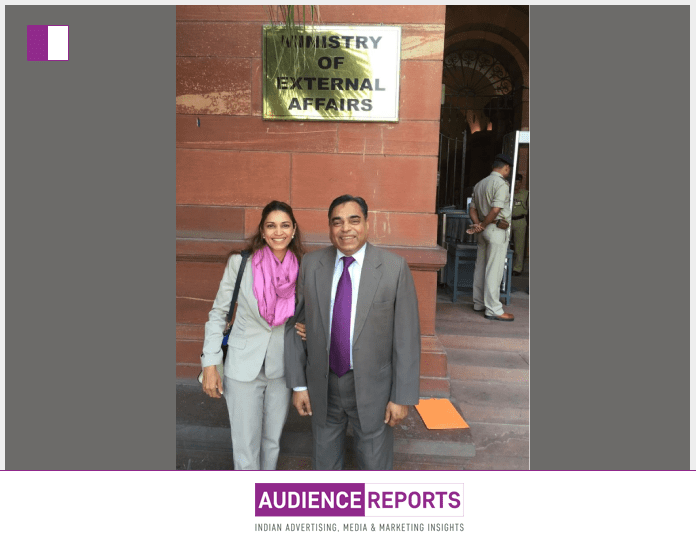
Gayatri Rangachari Shah grew up as the daughter of a diplomat, with a Kashmiri mother and a Tamil father. Her childhood was a journey across continents Hong Kong, Beijing, Islamabad, New York, Algiers, London, and eventually India. Each city and culture offered her unique experiences, shaping her worldview in profound ways. Yet, amid all this movement, she carried a recurring feeling: of never fully belonging anywhere.
Gayatri Rangachari Shah reflects on this sense of impermanence not as a limitation but as a lens through which she sees the world. The constant movement, she realized, was both a challenge and a gift. If she could not belong to one place, she had the ability to belong anywhere. This insight became central to her understanding of identity and connection, teaching her the skills of observation, adaptation, and attentive listening.

Gayatri Rangachari Shah also discovered the power of amplifying voices that often go unheard. Having felt like an outsider herself, she learned the importance of giving space to those who navigate marginality, whether in social, professional, or personal contexts. Her own experiences offered her a perspective that many rarely gain: the ability to notice what others might miss, to empathize deeply, and to act with sensitivity.
Belonging or the search for it is not unique to her experience. Gayatri Rangachari Shah observes that for women, this quest is almost universal. In families, women negotiate between their individuality and societal expectations. In in-laws’ homes, they are often asked to “adjust” until the process becomes a lifelong journey. At workplaces, women may find themselves as the “only one in the room” or pressured to conform to existing structures. Across contexts, the question remains: “Where do I truly belong?”
Gayatri Rangachari Shah emphasizes that belonging is not something granted; it is something created. It is a space carved deliberately, through persistence, reflection, and courage. It requires recognizing that belonging does not always mean fitting in. In fact, the truest form of belonging often comes from standing apart while still feeling valued and acknowledged.
For Gayatri Rangachari Shah, the constant shifts both geographic and personal served as lessons in adaptability and empathy. Each move, each new environment, taught her to understand diverse perspectives and to expand her own vision of the world. Where others might have seen instability, she recognized opportunity: the chance to grow, to observe, and to build connections across boundaries.
Gayatri Rangachari Shah’s reflections resonate deeply with many women navigating complex spaces. Her insights offer a blueprint for finding one’s place without compromising authenticity. Belonging is not dictated by geography, status, or social norms. It is defined by the ability to stand firmly in one’s purpose, to engage meaningfully with the world, and to acknowledge one’s own value.
The lessons Gayatri Rangachari Shah carries are practical and profound. First, belonging does not require assimilation. It requires clarity, self-respect, and the courage to assert one’s presence. Second, shifts whether in location, career, or personal life may be disorienting, but they also cultivate resilience, broaden understanding, and enhance empathy. These experiences allow one to contribute meaningfully to communities, teams, and relationships, even in spaces where one might initially feel like an outsider.
Gayatri Rangachari Shah’s approach to belonging emphasizes purpose over place. Her message is clear: we do not need to wait for external validation or acceptance. Instead, we can define belonging through our choices, values, and actions. Purpose-driven belonging offers stability amidst change, identity amidst diversity, and confidence amidst uncertainty.
In her work as a journalist, editor, and author at GRS Consultants, Gayatri Rangachari Shah exemplifies this philosophy. She navigates multiple roles, perspectives, and contexts with the awareness that her strength lies not in fitting in, but in contributing meaningfully wherever she is. Her story is a testament to the idea that belonging is an act of creation, not discovery.
Ultimately, Gayatri Rangachari Shah teaches that the search for belonging is not a journey toward a fixed destination. It is a process of embracing fluidity, cultivating empathy, and asserting purpose. By learning to belong to oneself, one can find connection in every environment, space, and relationship. Through her experiences, Gayatri Rangachari Shah inspires a broader understanding of what it means to truly belong: it is less about geography, more about intention, and entirely about the courage to carve one’s own space in the world.
Gayatri Rangachari Shah’s insights serve as a reminder that the questions we face about belonging are universal, but the answers are deeply personal. By embracing shifts, amplifying overlooked voices, and pursuing purpose, we create belonging not as an external condition but as an internal state of clarity and engagement. Through this lens, every challenge becomes an opportunity, every transition a learning, and every space a potential home.