






























Hem Shrestha begins with a simple, grounded idea: failure is not the opposite of success, it is the process that creates it. In a world that celebrates only outcomes, this perspective feels both practical and necessary. Hem Shrestha reminds us that what we often label as “setbacks” are actually signals. They are information. They are direction. They are the raw material of growth.
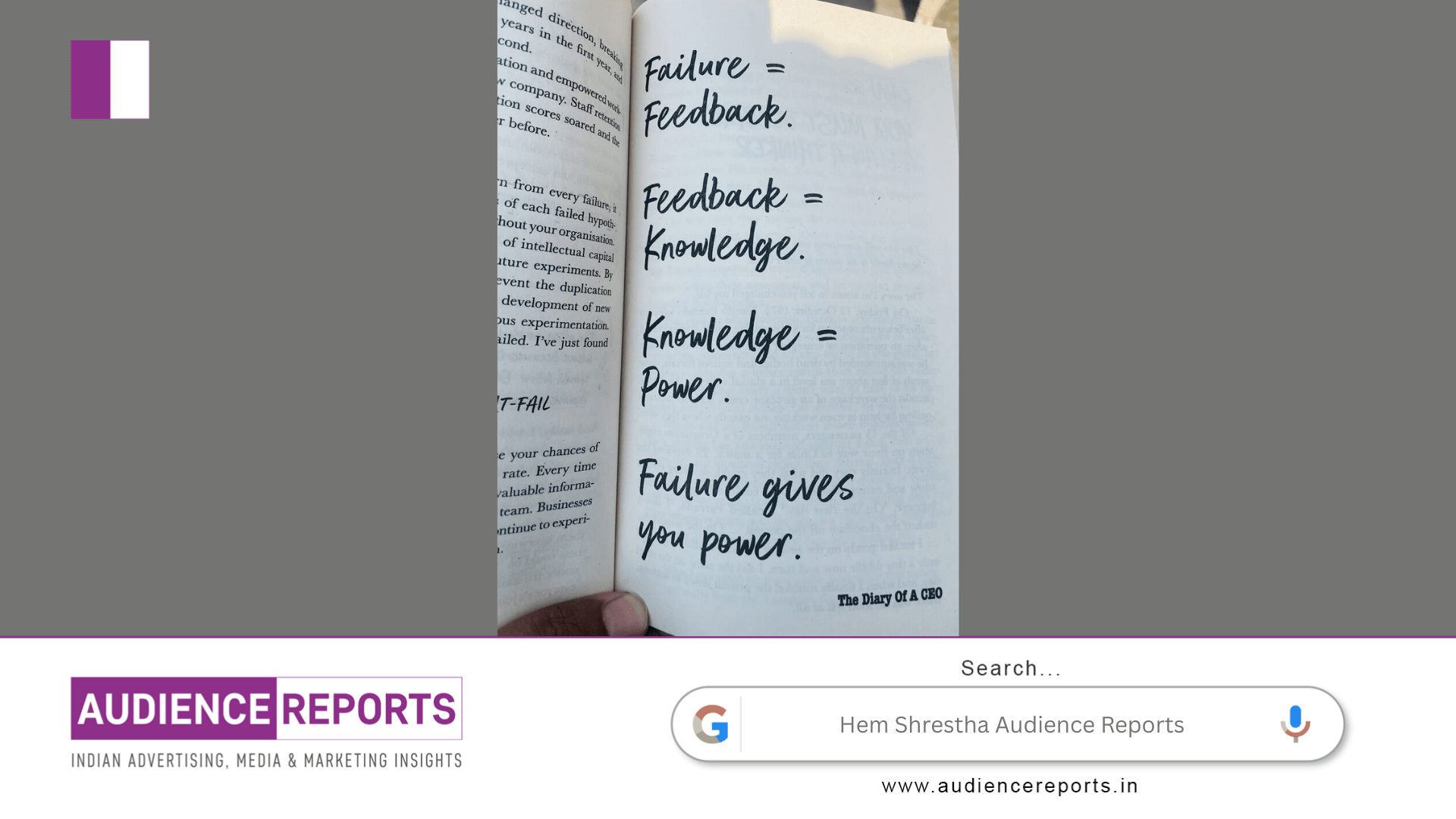
Hem Shrestha frames failure not as an emotional event, but as a functional one. “Failure = Feedback. Feedback = Knowledge. Knowledge = Power.” This is not motivational poetry; it is an operating system for leadership and progress. In technology, banking, and transformation work, systems evolve only when they are tested. Bugs reveal architecture flaws. Market resistance exposes weak assumptions. User behavior uncovers what design meetings could never predict. Hem Shrestha’s insight aligns with how real innovation happens, through iteration, not perfection.
What makes Hem Shrestha’s perspective compelling is its neutrality. Failure is not dramatized. It is not romanticized. It is treated as data. When something does not work, Hem Shrestha argues, it is not a personal verdict. It is clarity. It tells you what does not fit. It shows you where friction exists. It forces precision. This mindset is particularly relevant in leadership, where decisions ripple across teams and systems. Leaders who treat failure emotionally often become defensive. Leaders who treat it as data become adaptive.
Hem Shrestha highlights a critical distinction: the real mistake is not failing; the real mistake is failing and learning nothing from it. Many organizations fail repeatedly in the same way because they lack feedback loops. They move fast, but not thoughtfully. They celebrate speed but ignore reflection. In such environments, failure becomes noise rather than signal. Hem Shrestha points toward a different model, one where systems are designed to learn quickly. Post-mortems are honest. Metrics are meaningful. Teams are safe to speak. The goal is not to avoid mistakes but to shorten the distance between error and insight.
Every failure, Hem Shrestha notes, carries three gifts: insight into what doesn’t work, awareness of what must change, and strength to make better decisions next time. These gifts are not automatic. They appear only when attention is applied. Without reflection, failure hardens into fear. With reflection, it becomes leverage. This is true for individuals as much as for organizations. A professional who avoids mistakes often avoids growth. A professional who studies mistakes builds judgment.
Hem Shrestha’s thinking is especially relevant in digital transformation, where uncertainty is structural. New platforms, new regulations, new user behaviors, no roadmap survives intact. Leaders who demand certainty before action stall. Leaders who move without learning repeat errors. The advantage belongs to those who can run small experiments, observe honestly, and adjust quickly. Hem Shrestha’s framework transforms uncertainty from threat into terrain.
There is also a human dimension in Hem Shrestha’s message. People who rise, he writes, do not fear mistakes; they extract knowledge from them. This is not about bravado. It is about agency. When failure is interpreted as identity, “I failed, therefore I am inadequate”, it shrinks capacity. When failure is interpreted as information, “This failed, therefore something must change”, it expands options. Hem Shrestha places responsibility where it belongs: not on avoiding errors, but on listening to them.
In many professional cultures, failure is hidden. Reports are softened. Metrics are reframed. Risks are deferred. This creates an illusion of control while eroding learning. Hem Shrestha challenges this pattern by making failure visible and useful. Transparency becomes a growth tool. Curiosity replaces blame. Over time, this reshapes behavior. Teams experiment more. Leaders ask better questions. Decisions improve because they are grounded in evidence, not ego.
Hem Shrestha’s post also carries a quiet ethical stance. When leaders refuse to learn from failure, others pay the price, customers, employees, systems. Repeating the same mistake is not neutral; it is costly. Learning, in this sense, is a responsibility. It is how power is exercised wisely. “Failure gives you power, when you choose to listen to it,” Hem Shrestha writes. Power here is not authority; it is clarity. It is the ability to see reality as it is and act accordingly.
For individuals navigating careers in fast-moving fields, Hem Shrestha offers a durable compass. Progress will not be linear. Plans will misfire. Assumptions will collapse. The question is not whether this will happen, but how it will be processed. Will it be buried? Or will it be studied? The difference determines momentum.
Hem Shrestha does not promise comfort. He offers something more useful: a method. Treat outcomes as information. Design for learning. Shorten the feedback cycle. Separate identity from results. In doing so, failure loses its sting and gains its function. It becomes what it always was, a teacher.
By reframing failure as feedback, Hem Shrestha restores agency to leaders and learners alike. Growth stops being a matter of luck or genius and becomes a practice. Listen. Learn. Adjust. Repeat. In a world defined by change, that may be the most reliable form of power we have.