





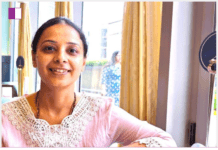








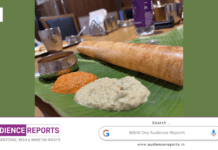










Nikhil Dey writes not from a place of performance, but from a place of pause. His reflection on living one month without his father is not framed as an announcement of loss, but as an observation of how absence rearranges daily life. Nikhil Dey begins with a simple moment, going to a familiar restaurant, ordering a favourite masala dosa, and through that ordinary act, grief finds a voice. It is not dramatic, not polished. It is lived.
What stands out in Nikhil Dey’s post is the permission he gives himself to feel. When a stranger says, “I hope you have had a good cry,” Nikhil Dey does not resist the idea. He accepts it. Tears, in his telling, are not weakness or interruption; they are part of processing. Nikhil Dey reminds us that grief is not something to be solved but something to be allowed.
Nikhil Dey also shows how memory is often anchored in places. Mysore Veg Cafe becomes more than a restaurant, it becomes a bridge between presence and absence. In sharing this, Nikhil Dey illustrates how remembering someone is rarely about grand gestures. It is about returning to the small rituals they loved and noticing how those rituals carry meaning forward.
As Nikhil Dey moves into his parents’ journey to Wayanad in 1994, the post quietly expands from personal loss to collective impact. The transformation of Wayanad over three decades is not framed as an achievement list, but as context. Nikhil Dey acknowledges his father’s role in shaping a region without turning it into praise. It is simply stated as fact, the way real legacies usually are, embedded in places and communities rather than headlines.
The poem left by a guest who never met his father becomes a powerful turning point. For Nikhil Dey, this moment confirms that influence does not require direct contact. Stories, spaces, and shared experiences allow lives to touch across time. Nikhil Dey reflects on this without explanation, trusting the moment to speak for itself.
What makes Nikhil Dey’s reflection resonate is restraint. He does not tell readers what to feel or how to interpret loss. Instead, Nikhil Dey listens, to conversations, to memories, to coincidences that feel larger than chance. When he says, “The universe speaks to us through these moments,” Nikhil Dey is not offering philosophy. He is describing attention.
In this post, Nikhil Dey shows that leadership, even outside boardrooms and titles, often looks like presence. Being present with family. Being present with memory. Being present with pain without rushing past it. Nikhil Dey does not close with certainty or closure. He closes with acknowledgment.
Through this reflection, Nikhil Dey demonstrates that grief can coexist with gratitude, that remembrance can be active, and that listening, to life, to loss, to quiet signs, may be one of the most honest responses we have.