






















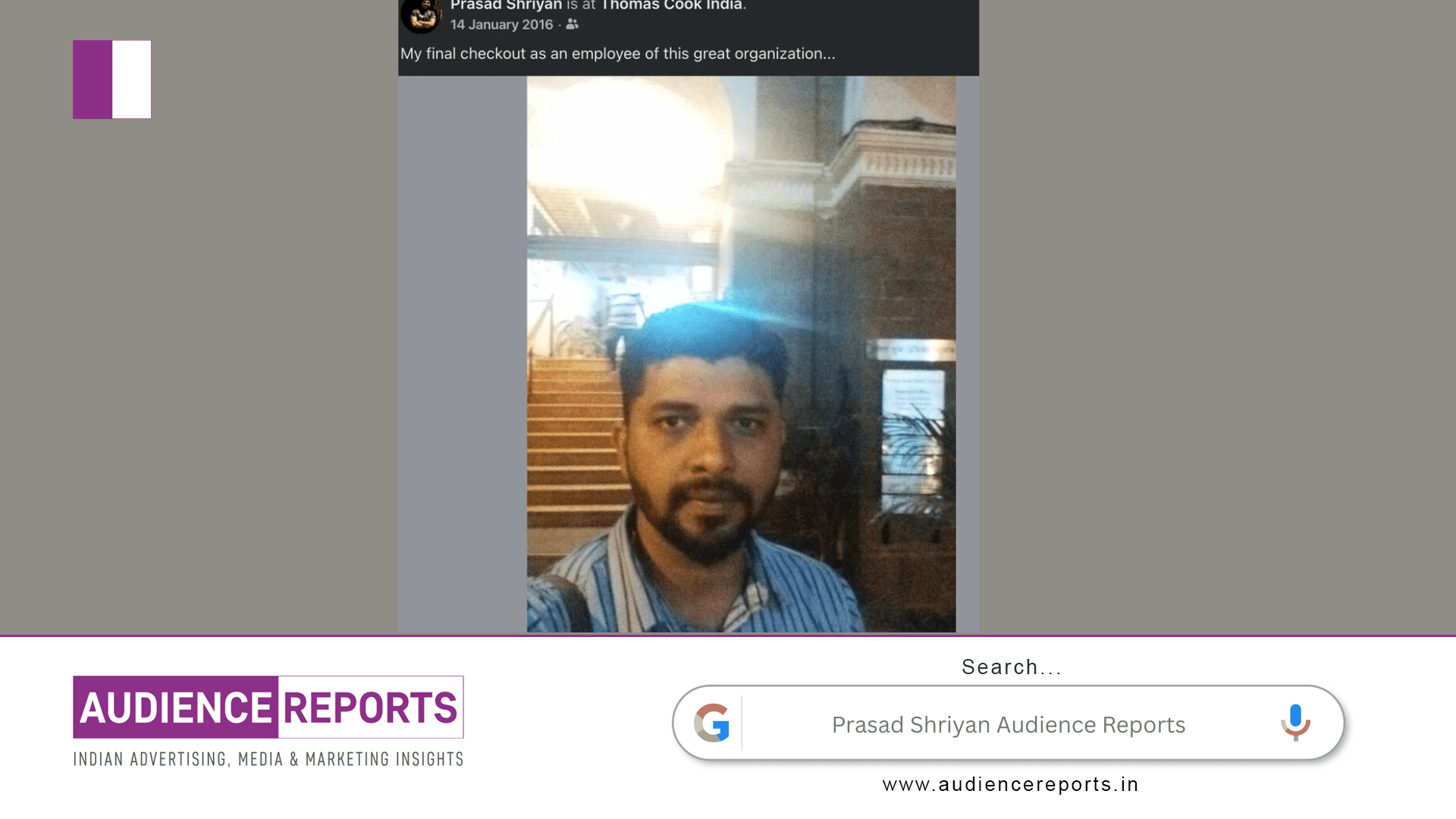
Prasad Shriyan did not frame his journey as a leap toward glory. He framed it as a step away from certainty. That distinction matters. In a culture that often celebrates disruption as spectacle, Prasad Shriyan speaks about transition as responsibility. Ten years ago, when he walked out of Thomas Cook after years of structured leadership, he did not know what he was building. He only knew he was choosing ambiguity over predictability.
The date 14-Jan-2016 marks more than a resignation. For Prasad Shriyan, it marks a shift in identity. From leading service delivery and go-to-market functions within a large organization, he moved into the unfamiliar terrain of entrepreneurship. What began as curiosity became commitment. The shift from advisor and investor to full-time co-founder of Drivify was not about chasing novelty. It was about discovering what leadership looks like without a safety net.
Prasad Shriyan’s account of that phase is grounded in reality. Four founders became two. Two became one. The journey did not expand in a straight line. It contracted, reshaped, and demanded endurance. Bootstrapping forced discipline. Pivoting from a consumer app to a B2B model required humility. Choosing restraint over acceleration showed maturity. Even when external interest emerged, Prasad Shriyan prioritized clarity over momentum. That decision reveals a form of leadership that values coherence more than noise.
The business stabilized, hired teams, expanded across cities, and then encountered the full force of COVID. These are not bullet points on a pitch deck. They are years of lived uncertainty. By 2023, Prasad Shriyan chose to exit. Not because belief was gone, but because leadership also means recognizing when it is time to step aside. This is a rarely discussed dimension of ambition. Knowing when to begin is celebrated. Knowing when to let go is often misunderstood.
What followed was not immediate clarity. Instead, Prasad Shriyan carried a question: how had those years actually changed him? The answer arrived only later, when he returned to Thomas Cook in 2024 to lead Corporate Accommodation and Business Transformation. Nearly two years into this role, the imprint of entrepreneurship became visible in how he worked.
Prasad Shriyan now thinks in horizons rather than cycles. This is not a stylistic preference. It is a structural shift. Entrepreneurs learn to live with deferred rewards. They learn that durable value rarely appears in quarterly frames. By bringing this lens back into a corporate environment, Prasad Shriyan bridges two worlds that often misunderstand each other. He does not romanticize either. He integrates them.
The lessons he describes are practical. Building through constraint teaches precision. Scaling responsibly teaches patience. Staying close to customer reality teaches relevance. These are not abstract leadership traits. They are habits formed under pressure. When applied thoughtfully, they create steadier execution and more durable outcomes.
Prasad Shriyan’s reflection challenges the idea that entrepreneurship is only about independence. It shows that entrepreneurship can be a formative phase rather than a permanent identity. Returning to an organization is not regression. In his case, it is translation, bringing hard-earned lessons into a different context.
There is no claim of superiority in his tone. Only gratitude. Gratitude for trust. Gratitude for the chance to apply experience alongside people he respects. This matters because leadership is often framed as ascent. Prasad Shriyan frames it as continuity. Growth does not always mean moving outward. Sometimes it means returning with depth.
The line “Some journeys don’t make you louder. They make you steadier” captures the essence of his decade. Steadiness is not passive. It is the ability to absorb volatility without losing direction. It is the capacity to act without being rushed by noise. It is the confidence to think beyond immediate wins.
Prasad Shriyan embodies a form of leadership that does not perform urgency. Instead, it cultivates perspective. Thinking in horizons means seeing transformation as a long arc. It means designing for resilience rather than applause. It means measuring success by impact on customers, shareholders, and the organization, not just by visible milestones.
In a professional landscape obsessed with speed, Prasad Shriyan offers a counter-narrative. He shows that progress can be quiet. That change can be cumulative. That maturity often looks like restraint.
His journey also reframes failure. The contraction from four founders to one is not presented as tragedy. It is presented as reality. The pivot from consumer to B2B is not described as defeat. It is described as learning. COVID is not dramatized. It is acknowledged. This tone reflects someone who has learned to separate experience from ego.
Prasad Shriyan’s return to Thomas Cook is not a return to comfort. It is a return with complexity. He brings with him the memory of building without structure, of deciding without precedent, of surviving without guarantees. These experiences now inform how he transforms within structure.
Ten years on, Prasad Shriyan does not declare victory. He declares evolution. The steadiness he speaks of is not stagnation. It is clarity.
In a world that often equates growth with volume, his story reminds us that growth can also be depth. That leadership can be measured not by how loudly one speaks, but by how calmly one moves through uncertainty.
Prasad Shriyan’s decade shows that stepping away from certainty is not about escape. It is about expansion. And sometimes, the greatest transformation is not in what we build, but in how we learn to hold complexity with composure.
That, ten years on, does feel like progress.