






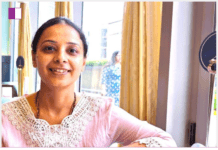


















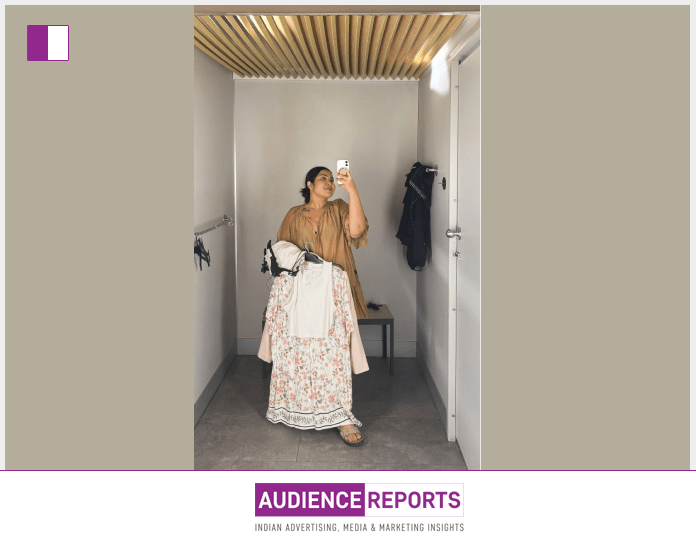
Sneham Choudhary has built her journey on a powerful insight how spaces influence the way people see themselves. Her reflections on fitting rooms highlight a deeper truth about confidence, perception, and the environments we walk into every day. Most of us step into a fitting room with the hope of discovering how a piece of clothing might express who we are, but as Sneham Choudhary points out, the very space meant to support this moment often ends up challenging it.
Sneham Choudhary observes that the design of fitting rooms is rarely neutral. Harsh lighting, poorly angled mirrors, and cramped spaces often distort not just the clothes on our body, but also the way we view ourselves. The result is an experience that can plant seeds of self-doubt in a matter of minutes. What should feel like a personal, affirming encounter often turns into a silent critique. By voicing this reality, Sneham Choudhary brings to light a rarely acknowledged but widely experienced issue: the power of environments in shaping confidence.
Sneham Choudhary’s perspective reminds us that fitting rooms are just one example of how external surroundings influence internal states. The way a space is structured can make us feel either grounded or judged, either uplifted or diminished. And while clothing itself is meant to help us express individuality, the space in which it is tried on can either amplify that expression or reduce it to insecurity. This is not simply about fashion it is about psychology, perception, and the subtle design of human experience.
When Sneham Choudhary founded Eham, she carried this awareness into her vision. Eham was not just imagined as a place to try on clothes, but as a sanctuary where people can reconnect with their true reflection. Through intentional design, thoughtful lighting, and supportive spaces, she worked to undo the silent pressures that conventional fitting rooms impose. In creating Eham, Sneham Choudhary sought to transform an ordinary retail interaction into a moment of healing and authenticity.
Sneham Choudhary understands this intimately because she has faced the same anxieties herself. She has walked into spaces that magnified self-doubt and experienced how surroundings can challenge even a strong sense of self. Her personal work on overcoming these fears allowed her to reimagine what others might need in similar situations. Eham thus became more than a business project; it became an extension of her own healing journey, shaped by empathy and grounded in lived experience.
This vision goes beyond fashion. What Sneham Choudhary highlights is a universal principle: that physical spaces carry emotional weight. A classroom, an office, a home, or even a waiting room each environment silently communicates messages that affect how people feel and behave. If a fitting room can make someone feel smaller, then a thoughtfully designed space can make someone feel whole. Sneham Choudhary’s work with Eham is therefore an invitation to reconsider the impact of our surroundings, whether in commerce or in daily life.
For those who step into Eham, the experience is not about being judged by mirrors but about being embraced by reflection. The focus is not on distortion but on alignment. Sneham Choudhary has created an atmosphere where people can pause, breathe, and truly see themselves as they are without the noise of engineered insecurities. That simple shift has the power to turn doubt into acceptance, hesitation into curiosity, and anxiety into freedom.
In her message, Sneham Choudhary asks us to pause the next time we try something on and notice the space itself. That pause is powerful. It brings awareness to what often goes unnoticed: that the architecture, lighting, and energy of a space are not neutral backdrops but active participants in shaping how we feel. By drawing attention to this, Sneham Choudhary is not only reshaping fashion spaces but also raising consciousness about the environments we all inhabit.
There is something deeply human in what Sneham Choudhary emphasizes. Everyone has moments of self-doubt. Everyone has stood before a mirror and wondered if what they see is truly them or just an illusion created by angles and lights. By designing a space where people feel comfortable and seen, she is reminding us that our worth is not determined by distorted reflections but by the authenticity we carry within.
Ultimately, Sneham Choudhary’s work with Eham is about dignity and freedom. It is about creating conditions where people can experience themselves without judgment. It is about restoring confidence not through external validation but through an environment that nurtures self-recognition. In this sense, Sneham Choudhary is not only redefining fitting rooms but also offering a broader lesson on leadership: that the smallest design choices can have the deepest impact on human emotions.
Sneham Choudhary shows us that innovation does not always come from technology or trends it often comes from empathy, from noticing what others overlook, and from reimagining simple experiences with greater care. Her journey reminds us that the spaces we build physical, emotional, or professional carry the potential either to confine or to liberate. And when they are built with awareness, they can become places of growth, confidence, and healing.