
























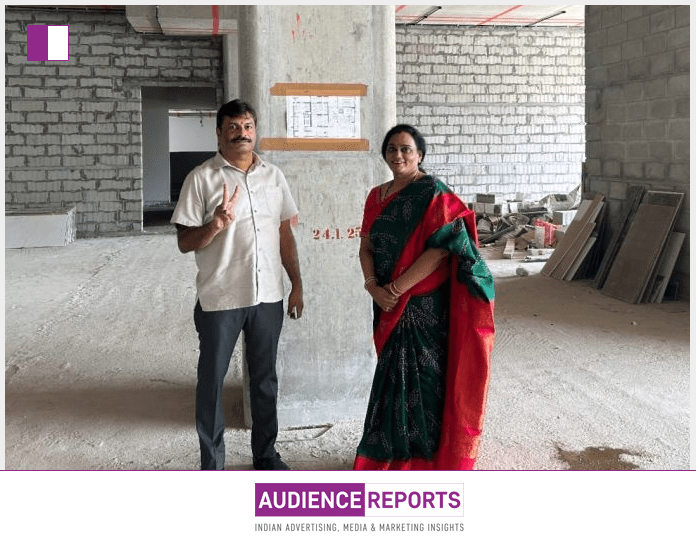
Sohini Badvelu has a way of seeing beauty in moments that most people overlook. In her recent reflection, she captures an idea that resonates deeply across professions, generations, and personal journeys that progress doesn’t always come wrapped in ribbons or announced with applause. It often hides quietly within unfinished walls, half-drawn plans, and moments of quiet observation. For Sohini Badvelu, that truth came alive not in a boardroom or at a ribbon-cutting ceremony, but in a work-in-progress experience centre visited with her parents on Vijayadashami a day symbolic of victory, learning, and renewal.
Sohini Badvelu reminds us that the most meaningful milestones are rarely recognized while they are happening. The raw stages, the scaffolding, and the dust of creation hold more emotion than the final, polished product. Her words resonate with anyone who has ever waited for the perfect moment to begin, to celebrate, or to acknowledge progress. By pausing in that unfinished space with her parents, Sohini Badvelu demonstrates something profound that celebration does not require completion; it requires presence.

In a world obsessed with “finished,” Sohini Badvelu offers a gentle challenge: What if we learned to value “in- progress”? Her reflection is not just about construction or business; it’s a metaphor for life itself. Most of us live surrounded by drafts unfinished careers, incomplete dreams, evolving relationships, and ongoing personal growth. Yet, like the experience centre she visited, these drafts are filled with meaning if only we choose to notice.
Sohini Badvelu’s insight draws attention to a universal truth waiting for perfection can often mean missing the beauty of becoming. The world often teaches us to measure worth in terms of results, certificates, or polished outcomes. But Sohini Badvelu brings us back to something more human the joy of the journey itself. Progress, she reminds us, is not always about grandeur but about gratitude gratitude for how far we’ve come, even if the destination is still under construction.
Standing amid unfinished walls, Sohini Badvelu didn’t just see a site in progress; she saw a story unfolding. The presence of her parents in that moment symbolized something deeper the quiet pride that comes from shared effort and vision. For them, and for her, the space represented not just a building, but a journey years in the making. It’s easy to celebrate the end product, but it takes a reflective mind like Sohini Badvelu’s to find significance in the still-forming chapters.
The way Sohini Badvelu connects her professional world to her personal reflections is striking. As Director at Vamsiram Builders, she operates in a space where “completion” is often the ultimate goal buildings finished, projects handed over, structures standing tall. Yet her words suggest a different kind of leadership, one that values evolution over arrival. It’s a reminder that the heart of creation whether in architecture or in life lies in patience and appreciation of process.
When Sohini Badvelu writes that “most milestones don’t look like milestones while they’re happening,” she captures the quiet truth behind every success story. Progress rarely announces itself. It appears as early mornings, long plans, and quiet persistence. The glory we see at the end is built on the unnoticed days of effort. By celebrating these in-between moments, Sohini Badvelu shows emotional intelligence and grounded leadership traits that transform not only workplaces but also the people within them.
For many, her reflection becomes a mirror asking us to reconsider how we define success. Is it only when the façade is polished and the lights are on? Or could success also be found in the sketches, the conversations, the first beams being placed, the silent pride in a parent’s eyes? Sohini Badvelu’s story invites us to find meaning in the making, not just in the made.
The message of Sohini Badvelu extends beyond construction sites and into everyday life. Every learner struggling through a new skill, every entrepreneur working on an early-stage idea, every artist perfecting their craft all live in this space of becoming. What if we stopped waiting for validation to celebrate our effort? What if, like Sohini Badvelu, we allowed ourselves to pause amid the incomplete and simply say, “This too matters”?
Sohini Badvelu’s reflection also carries a sense of humility and gratitude. Her visit with her parents is not just a personal moment but a universal reminder that behind every progress stands the quiet support of those who believe in us. It’s easy to get lost in ambition, but she reminds us to stay anchored in the relationships and values that shape our purpose.
The thought she echoes “waiting for perfection often means missing the significance of what’s unfolding right now” is a timeless lesson. Life is always unfolding, and every stage has its own significance. To live meaningfully, as Sohini Badvelu suggests, is to notice the quiet victories before the grand ones, to find worth in the unfinished, and to hold gratitude in moments of becoming.
In a society driven by deadlines and deliverables, Sohini Badvelu’s words breathe calm into the noise. They encourage us to find contentment not in completion but in connection to people, to purpose, to progress. Her reflection is not about slowing down success but about redefining what it means to be successful.
Ultimately, the perspective of Sohini Badvelu reminds us that every great creation be it a building, a business, or a life is first a collection of imperfect steps. Each phase, though incomplete, contributes to something greater. And perhaps the truest form of success is learning to stand in the middle of the mess, look around, and still feel grateful.
Through her thoughtful lens, Sohini Badvelu teaches that the journey itself deserves recognition because even when the walls are unfinished and the plans are still taped to a column, something extraordinary is already taking shape.