





























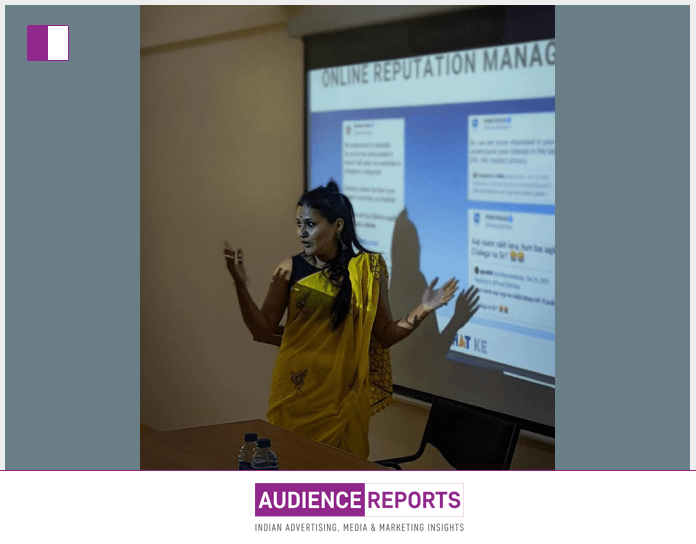
Sunchika Pandey begins with a simple question: Why do you check the weather forecast? At first glance, it might seem like a trivial inquiry, but Sunchika Pandey uses this everyday action to highlight a deeper truth about communication. We check the weather not for abstract knowledge, but for personal relevancewhether to carry an umbrella, avoid a traffic jam, or plan a safe weekend. Sunchika Pandey’s insight is clear: people respond when the information directly affects them. This principle forms the foundation of her approach to media and crisis communication.
Sunchika Pandey identifies a critical gap in how national issues and public safety alerts are communicated. Most messages fail to resonate because people perceive them as distant events“happening somewhere else, to someone else.” This detachment makes communication ineffective, no matter how urgent the content. According to Sunchika Pandey, the key to bridging this gap is turning the audience into the main character. It is not enough to present facts; the challenge is answering the unspoken question in everyone’s mind: “Why should I care?”

Sunchika Pandey illustrates this with a straightforward example. Consider the difference between saying, “Waterlogging has been reported in Andheri,” versus “Your route home through Andheri is flooded. Use the S.V. Road diversion to get home safely.” The first statement is merely a headline. The second becomes a lifeline. Sunchika Pandey emphasizes that the effectiveness of any communication lies in this translationfrom the macro to the micro, from the abstract to the personal.
In her work at HAT Media, Sunchika Pandey applies this principle rigorously. She and her team specialize in crisis communication with police departments, but the lessons extend far beyond public safety alerts. Every message, in Sunchika Pandey’s view, has the potential to impact real people’s livesbut only if it is framed in a way that connects directly to their experience. She treats each audience member not as a statistic, but as a participant in the story. By speaking in the language of personal impact, Sunchika Pandey ensures that information is not just heard, but acted upon.
This approach also challenges conventional thinking about communication strategy. Sunchika Pandey rejects the notion that mass communication is effective simply by being widespread. Instead, she demonstrates that scale alone does not guarantee engagement. What matters is precisioncrafting messages so that individuals see their own circumstances reflected in the information. In doing so, Sunchika Pandey reshapes how organizations understand their audiences, making relevance the guiding principle of every campaign.
Sunchika Pandey’s philosophy has broader applications beyond crisis management. In marketing, public policy, or social campaigns, the same principle holds: people respond when they feel personally addressed. By transforming abstract data into actionable insights that touch individuals’ lives, Sunchika Pandey illustrates a universal truth about human behavior: relevance drives attention, and attention drives action. Messages that ignore personal impact, by contrast, are quickly filtered out as background noise.
An essential part of Sunchika Pandey’s framework is clarity. She focuses on removing ambiguity so that the audience immediately understands both the risk and the response. When communicating during emergencies, every second counts, and Sunchika Pandey ensures that the audience’s next step is unambiguous. By translating large-scale events into actionable personal guidance, she empowers people to make informed decisions, enhancing both safety and trust in the institutions delivering the messages.
Sunchika Pandey also highlights the psychological dimension of engagement. People naturally filter out information that feels irrelevant. By speaking directly to the personal stakes, she overcomes this barrier. In effect, Sunchika Pandey converts passive observers into active participants. Her methodology reinforces the idea that communication is not a one-way broadcast, but a conversation where the audience’s context shapes the message. The most effective communication, she demonstrates, is always empathetic, strategic, and individualized.
Moreover, Sunchika Pandey’s insights extend to the broader field of leadership and management. Leaders who communicate with awareness of personal relevance inspire higher levels of engagement and accountability. By focusing on how policies, alerts, or updates affect each person directly, Sunchika Pandey shows that transparency and clarity are not just ethical practicesthey are practical tools for mobilization. Organizations that adopt this mindset can reduce confusion, prevent misinterpretation, and foster a culture where information is valued rather than ignored.
Ultimately, the core lesson from Sunchika Pandey’s work is that relevance is the engine of communication. Every message, from the simplest weather update to the most critical safety alert, carries weight only when it touches individuals personally. By prioritizing personal impact, translating the macro into the micro, and addressing the silent question of “Why should I care?”, Sunchika Pandey redefines the standards of effective communication. Her approach is a reminder that in a world saturated with information, the most powerful messages are those that connect to the lives of the people they are meant to serve.
In a time when attention spans are fragmented and public trust is fragile, Sunchika Pandey’s methodology offers a practical, human-centered blueprint. She demonstrates that clear, personally relevant communication is not just a tacticit is a necessity. And in that clarity lies the difference between noise and lifeline. Sunchika Pandey shows that when we make individuals the focal point of our messaging, we do more than inform; we enable, empower, and protect.