

































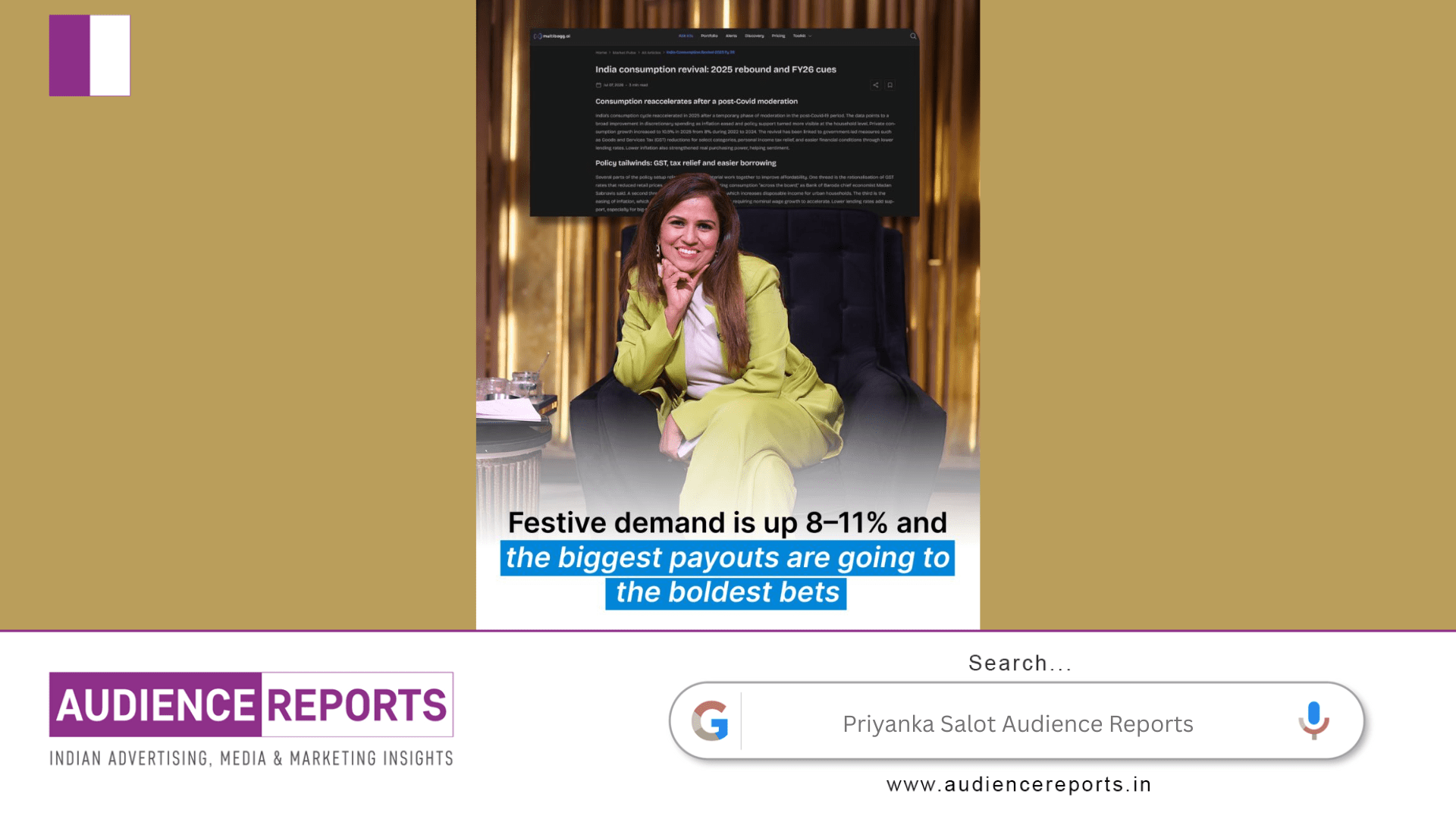
Priyanka Salot understands that leadership is not always about having perfect information. Sometimes, it is about making a difficult decision when the information is incomplete, the room is uncertain, and the consequences are real. Her recent reflection on managing inventory ahead of the festive season captures a powerful lesson about business: timing can matter just as much as strategy.
Priyanka Salot’s story begins with rejection. Five and a half years ago, investor after investor questioned whether a premium mattress business could scale in India. The doubts were not limited to the price. There were questions about whether consumers would care about mattress technology and whether the business numbers could support the vision. Instead of allowing those opinions to define the opportunity, Priyanka Salot continued building.
That persistence is important because entrepreneurship rarely provides immediate validation. A founder can have a strong market insight and still spend years hearing that the idea will not work. Priyanka Salot’s experience demonstrates that rejection does not necessarily mean an idea is wrong. Sometimes, it simply means the market has not yet produced enough evidence for others to see what the founder sees.
But persistence alone is not enough.
The festive season example reveals another side of leadership: the ability to act before certainty arrives. According to the data referenced in Priyanka Salot’s post, festive spending increased significantly, while furnishings were among the categories experiencing strong demand. For businesses operating with long inventory lead times, the crucial decisions were made well before customers actually walked into stores or placed orders.
This is where Priyanka Salot highlights a fundamental business principle. When demand is predictable but timing is uncertain, waiting for complete confirmation can become its own risk.
A company that waits until the market clearly demonstrates demand may feel safer. Yet by then, suppliers may be committed elsewhere, production capacity may be constrained, and inventory may take too long to arrive. The company has protected itself from the risk of over-ordering, but it may have created another risk: missing the opportunity entirely.
Priyanka Salot’s decision to place a large inventory order two months before the festive season was therefore not simply an inventory decision. It was a judgment call. The decision required her to interpret signals, understand lead times, evaluate consumer behavior, and accept that the prediction could have been wrong.
That is an uncomfortable reality of leadership.
Priyanka Salot also makes an interesting distinction between consensus and conviction. She acknowledges that the inventory decision was not unanimously supported even within her own team. Yet she understood that waiting for everyone to agree could cost the business valuable time.
Consensus has its place. It can improve decisions by bringing different perspectives into the room. But consensus should not become a requirement for every meaningful decision. In fast-moving markets, someone eventually has to take responsibility for making the call.
Priyanka Salot’s experience illustrates why founders need to develop judgment rather than simply collect opinions. Data can inform a decision, teams can challenge assumptions, and advisors can offer perspective. But when the decision window closes, leadership means choosing.
There is also a deeper dimension to the statement about being a woman on a factory floor and not automatically receiving the benefit of the doubt on a major order. It points toward the additional scrutiny women can encounter in operational and commercial environments. Instead of treating that observation as a reason for sympathy, Priyanka Salot turns it into a reminder that credibility is often built through repeated execution.
The strongest response to doubt is not always an argument. Sometimes, it is performance.
When a decision produces the expected result, the outcome becomes evidence. When it fails, the lesson becomes evidence too. Either way, serious leaders must be willing to own the decision rather than hide behind collective uncertainty.
Priyanka Salot’s journey also challenges a common misconception about scaling a consumer brand. Growth is not created only through advertising, product launches, or attractive positioning. Behind the visible brand are quieter decisions about manufacturing, supply chains, inventory, forecasting, capacity, and timing. A customer may see a mattress on a showroom floor, but a founder has to think months ahead about whether that mattress will even be available when demand arrives.
Priyanka Salot’s post ultimately presents entrepreneurship as a discipline of calculated commitment. The goal is not to predict the future perfectly. The goal is to develop enough understanding to act intelligently before the future becomes obvious.
That lesson extends beyond retail or mattresses. It applies to hiring, technology, manufacturing, marketing, fundraising, and almost every entrepreneurial decision. Markets rarely announce the perfect moment in advance. Opportunities often become obvious only after someone has already acted on them.
Priyanka Salot therefore leaves readers with a useful question: what decision are you postponing because you are waiting for everyone else to agree?
The answer may reveal something about your leadership style.
Priyanka Salot’s example does not suggest that moving first is always better. Acting early without evidence can be reckless. The real skill is knowing when the available evidence is sufficient to justify commitment, even when certainty is impossible.
Priyanka Salot’s story is ultimately about that distinction. Courage is not ignoring risk. It is understanding risk well enough to make a decision despite it.
And in business, sometimes the biggest advantage does not belong to the person who knows the future.
It belongs to the person who recognizes the moment when waiting has become more dangerous than acting.