




























Julie Estcourt began writing on Substack without a grand strategy for building an audience. At the same time she was building Without Ceremony Fine Jewelry, she wanted somewhere to document the process: what she was creating, what she was learning, what she was questioning, and the things that captured her attention. What started quietly has gradually become something more meaningful a small community forming around the story behind the work.
Julie Estcourt’s experience offers an important perspective on what it means to build a brand today. There is often pressure on founders to make every post purposeful, every piece of content measurable, and every communication designed to generate an immediate result. But Julie Estcourt’s story suggests that there is value in simply allowing people to see the journey.
For a while, nothing much happened.
That is an experience many creators and entrepreneurs understand. You can publish something thoughtfully and receive very little response. You can spend time explaining an idea and wonder whether anyone is paying attention. The quiet period can easily become discouraging because modern digital platforms often make success look immediate.
Julie Estcourt continued writing anyway.
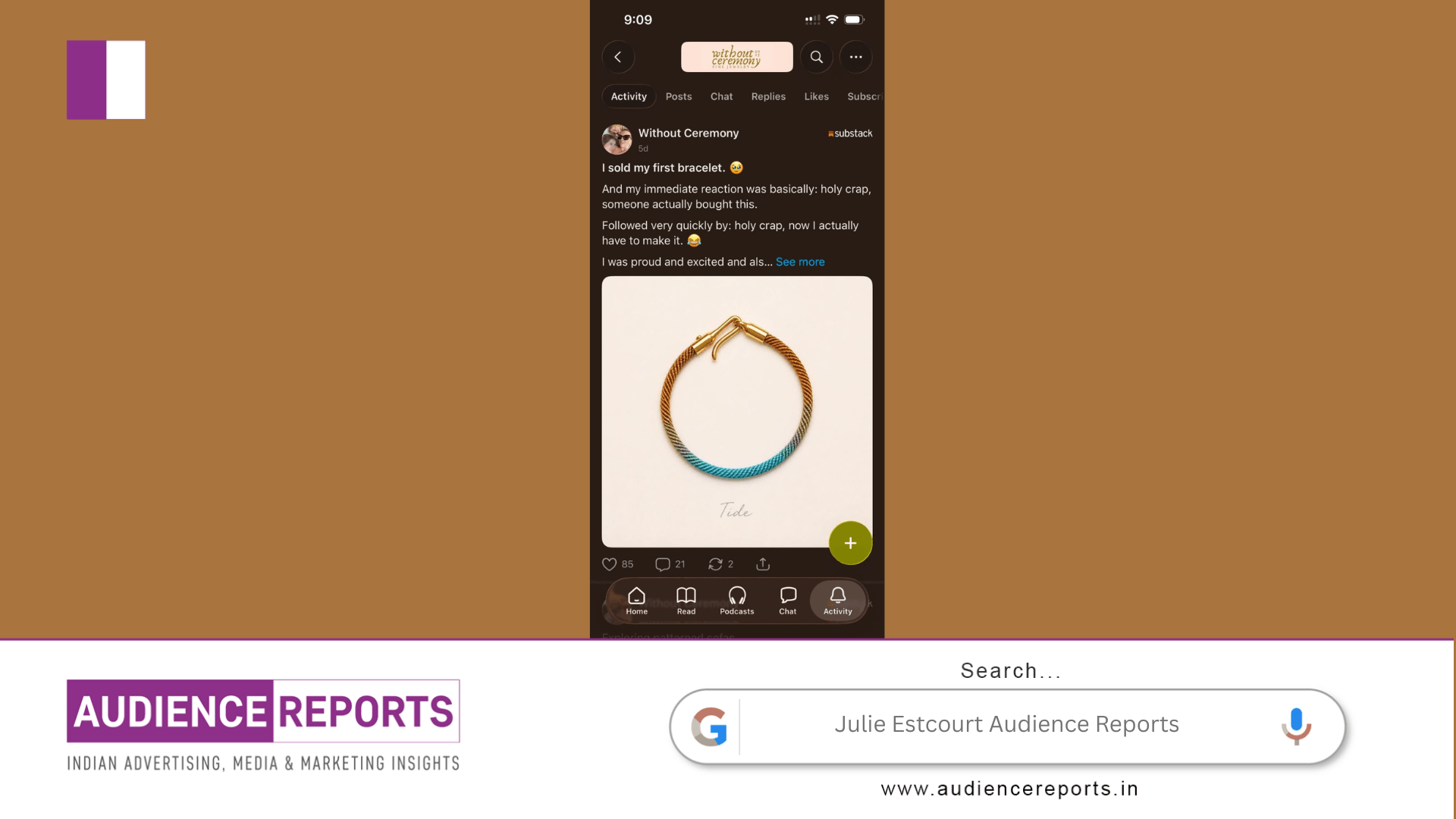
Then the numbers began to change. One of her Substack Notes passed 100 likes, another moved into the 70s, and more people started commenting and following her work. On their own, these numbers are not necessarily evidence of a successful business. Julie Estcourt makes that distinction herself, and it is one of the most grounded parts of her reflection.
The more interesting development happened beyond the numbers.
Two women she had never met purchased Bond Bracelets after discovering her through Substack. For Julie Estcourt, the significance was not simply that two products had been sold. It was that two strangers had encountered the story, stayed long enough to understand what she was creating, and eventually decided that they wanted to own something connected to that story.
That is a different way of thinking about conversion.
A transaction can happen quickly. A relationship usually takes longer.
Julie Estcourt’s experience highlights how content can create familiarity before a customer ever considers making a purchase. When someone repeatedly sees a founder’s ideas, experiments, questions, interests, and creative process, the brand begins to become more than a logo or product catalogue. There is context around it.
For a small business, that context can matter.
Without Ceremony Fine Jewelry is not being introduced solely through finished pieces. Julie Estcourt is also allowing people to observe the thinking and making behind those pieces. That approach creates an opportunity for customers to understand not only what is being sold, but why it exists.
This is particularly relevant for independent brands competing in crowded markets.
Large companies can often rely on advertising budgets, established recognition, distribution networks, and constant visibility. Smaller businesses may have fewer resources. What they can offer, however, is proximity. Customers can see the person, process, perspective, and decisions behind the business.
Julie Estcourt’s Substack journey demonstrates how that proximity can develop gradually.
It also challenges the assumption that community and marketing are completely separate activities. Julie Estcourt is beginning to see that building a brand and building a community may actually overlap. Sharing what interests you, showing what you are making, and being transparent about what you are learning can attract people who genuinely connect with the direction of the work.
That does not mean every follower becomes a customer.
Nor should they.
A healthy community is not simply a collection of potential buyers. It can include readers, supporters, fellow creators, curious observers, collaborators, and people who simply appreciate the ideas being shared. Julie Estcourt’s invitation for others to share what they are building reflects this broader understanding.
There is another lesson in her post: patience.
Julie Estcourt started writing on Substack when there was little visible evidence that it would contribute meaningfully to her business. The results came later, and even then, she did not interpret a few positive signals as proof that everything had suddenly worked.
That restraint matters.
Entrepreneurship rarely develops in a perfectly predictable sequence. An activity that seems insignificant today may become useful months later. A conversation may lead somewhere unexpected. A piece of content may reach someone who does not respond immediately but remembers the brand when the right moment arrives.
Julie Estcourt is still at the beginning of that process, by her own admission.
That may be the most useful part of the story.
Instead of presenting community-building as a formula, Julie Estcourt describes it as something emerging through consistency and genuine participation. She is sharing the work while doing the work. She is allowing the audience to see the unfinished parts rather than waiting until everything looks polished.
For founders, that can be a valuable approach.
You do not always need to have the complete story before you start telling it. You can document what you are discovering along the way. You can share questions as well as answers. You can let people understand the evolution of an idea instead of presenting only the final outcome.
Julie Estcourt’s Substack experience is ultimately a reminder that meaningful audiences are often built through repeated, honest interaction rather than sudden bursts of attention.
A hundred likes can be encouraging. Seventy comments can create momentum. Two unexpected customers can provide a powerful signal.
But the deeper opportunity is what happens between those moments: people discovering your work, understanding your perspective, returning to hear more, and gradually deciding that they want to be part of the journey.
Julie Estcourt has not presented community-building as a finished achievement. She has presented it as something she is learning in real time. And perhaps that is precisely why the story resonates. Building a brand does not always begin with knowing exactly where the audience will come from.
Sometimes, it begins with simply having something worth sharing and continuing to share it long enough for the right people to find it.