
































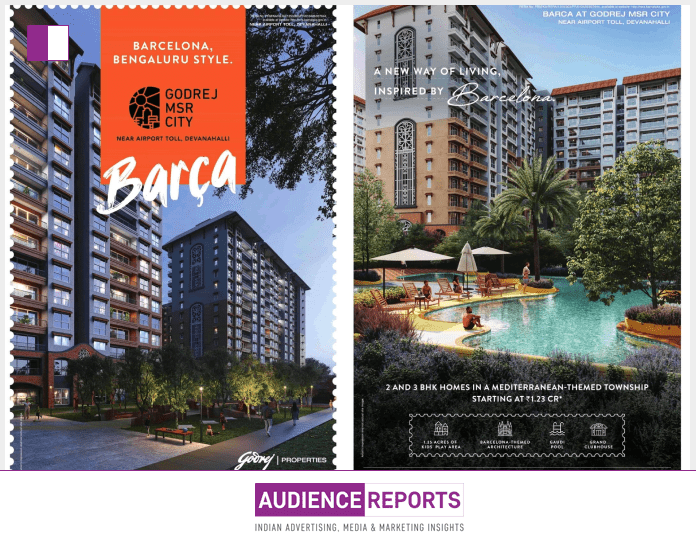
The Economic Times once again demonstrates its unwavering influence in India’s advertising landscape by featuring the latest luxury real estate marvel, Godrej MSR City, in today’s Bangalore edition. This isn’t just an advertisement; it’s a statement. As a strategic brand showcase in The Economic Times, the print ad does more than inform, it inspires, engages, and elevates the positioning of both the brand and the publication.
The Economic Times has long been the preferred platform for brands that wish to reach an audience that matters, affluent decision, makers, senior executives, investors, and future, forward thinkers. And when a legacy brand like Godrej Properties chooses The Economic Times to unveil Godrej MSR City, it tells us one thing loud and clear: the power of print in premium real estate marketing is not just alive, it’s thriving.
The Economic Times: Where Trust Meets Branding
The Economic Times is not merely a newspaper; it’s an ecosystem of trust and authority. For over five decades, it has shaped financial discourse in boardrooms and policy circles alike. In advertising, the context in which your brand appears is everything, and The Economic Times provides exactly that: an environment of credibility, aspiration, and influence.
The decision to advertise Godrej MSR City in The Economic Times goes beyond media planning, it’s a branding masterstroke. It tells the readers that this project, located near Bangalore Airport’s Trumpet Road, is not just another housing complex. With 62 acres of design and 20 acres of green serenity, it is a future landmark, and it belongs in The Economic Times.
The Economic Times Format: Where Presentation Meets Precision
Visually, the advertisement upholds everything The Economic Times stands for, sophistication, restraint, and elegance. The layout respects the white space, offering breathing room that accentuates the architectural visual of Godrej MSR City. The headline is crisp. The offer is clear. The pricing is premium, starting at ₹1.18 Crores, and yet the tone is inviting, not intimidating.
What works exceptionally well here is the alignment of visual storytelling with audience expectations. The affluent readers of The Economic Times don’t need to be sold to, they need to be inspired. The ad does precisely that by blending minimalism with magnetism.
The Economic Times and the Psychology of Print
In a world increasingly ruled by digital saturation, The Economic Times remains a tactile, focused, and immersive experience. Ads in print aren’t just scrolled past, they’re noticed, read, and retained. According to recent marketing studies, readers of print publications like The Economic Times spend more time on ads and attribute higher credibility to them compared to their digital counterparts.
This makes the newspaper an ideal channel for showcasing a premium offering like Godrej MSR City, a project that promises not just homes but lifestyles, not just luxury but legacy.
Godrej MSR City: A Brand Built for Aspirational India
The product being advertised, Godrej MSR City, is as compelling as the platform that carries it. Situated strategically near Bangalore’s growing northern corridor, the project promises cutting, edge architecture and expansive greens within a sprawling 62, acre master plan. With 4000 units in 2 BHK and 3 BHK formats, the scale matches the ambition.
By choosing The Economic Times as the first reveal point, Godrej Properties taps into a readership that’s not just interested in buying homes, they’re looking to invest in a future. And this project, with its blend of connectivity, lifestyle, and brand pedigree, ticks every box.
The Economic Times as a Brand Amplifier
What makes The Economic Times unique in advertising is that it doesn’t dilute the brand voice, it amplifies it. When your brand sits alongside thought leadership articles, stock market analyses, and policy deep, dives, it gains prestige by association.
For Godrej Properties, that association adds a layer of premium validation. A consumer might see a real estate ad elsewhere, but seeing Godrej MSR City in The Economic Times makes it an opportunity, not just an offer. It enhances recall, boosts trust, and fast, tracks the consideration process.
The Economic Times: Why Print Still Wins
Targeted Influence: With a readership base consisting of CXOs, entrepreneurs, and investors, The Economic Times reaches the exact audience luxury real estate needs.
High Engagement: Unlike fleeting digital impressions, print offers higher attention span and deeper brand interaction.
Premium Perception: Ads in The Economic Times are perceived as more prestigious and trustworthy.
Legacy and Authority: Advertising in The Economic Times is not just a media choice, it’s a brand statement.
Final Thoughts: The Economic Times as the Enduring Stage for Iconic Brands
In today’s saturated media world, The Economic Times stands tall as a beacon of trusted journalism and premium advertising. For brands like Godrej Properties, it offers the perfect platform to tell stories that resonate beyond the page, stories of ambition, vision, and excellence.
The feature of Godrej MSR City in The Economic Times isn’t just a marketing tactic, it’s a strategic brand placement. It aligns heritage with aspiration, content with context, and luxury with legacy. As long as brands seek to communicate with depth, dignity, and distinction, The Economic Times will remain their most powerful print ally.
And today’s feature? A brilliant reminder that great print still builds great brands, twelve mentions strong.