


































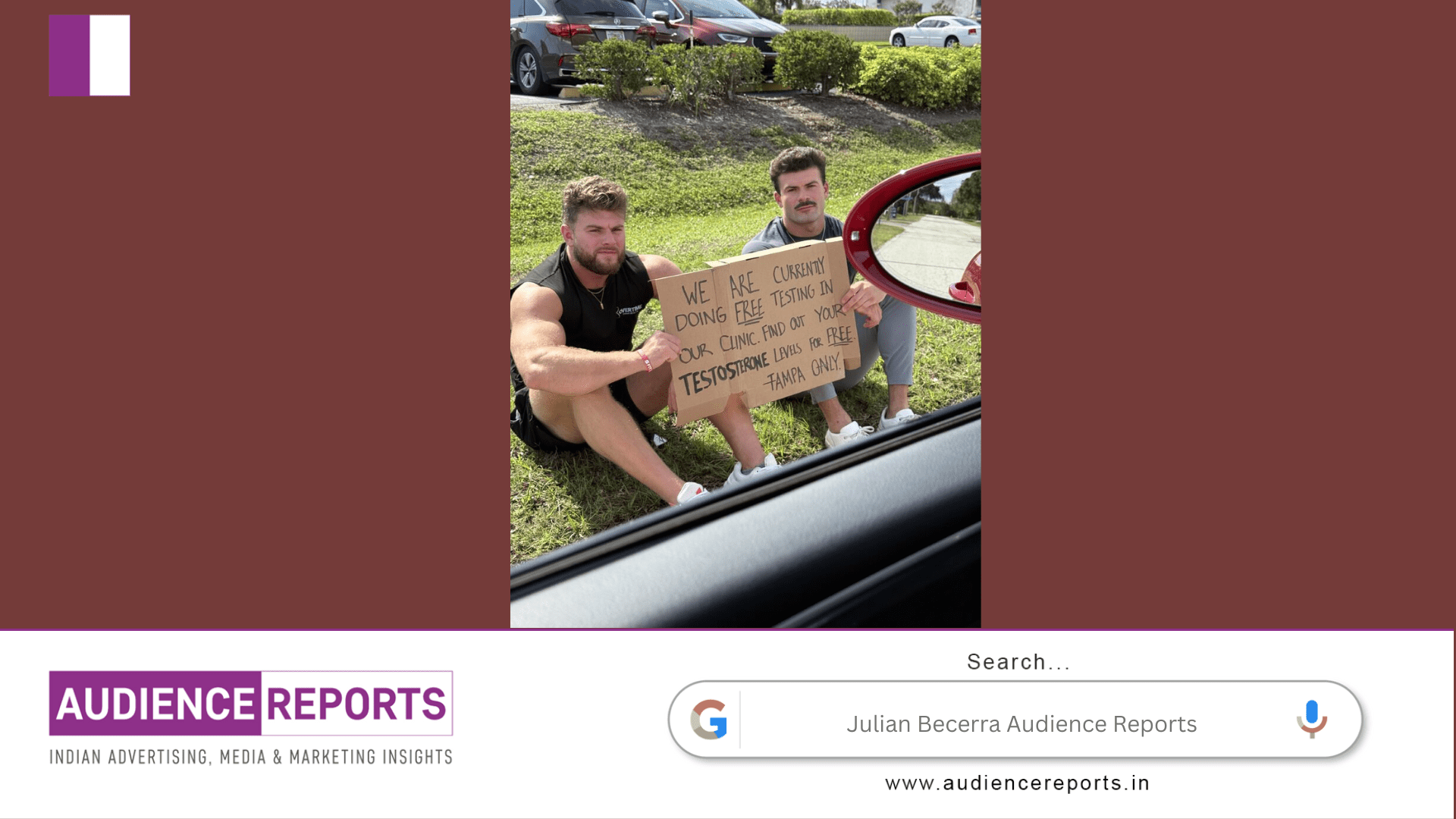
Julian Becerra built his early vision around a plan that seemed ambitious at the time: create a performance health clinic in Tampa, operate it successfully, and gradually expand into nearby markets. At 23, that vision represented a significant goal. It was concrete, measurable, and understandable. Yet the most important lesson from Julian Becerra’s journey is that the plan was not what ultimately created the larger opportunity. The willingness to move beyond the plan did.
Julian Becerra’s story challenges the common belief that successful entrepreneurs always know exactly where they are going. Business culture often celebrates detailed strategies, five-year plans, market projections, and carefully calculated expansion models. Those things have value, but Julian Becerra shows another side of entrepreneurship: sometimes the greatest opportunities appear only after the original plan stops being enough.
When Julian Becerra and his co-founder started their performance health clinic, the ambition was local. The idea was to build something strong in Tampa and expand outward over time. There was nothing wrong with that strategy. In fact, having a clear direction helped create momentum. But the unexpected influence of social media changed the equation.
The clinic began reaching people far beyond the geographic market it had originally imagined serving. Individuals from states where the company had no physical presence began asking whether Overtime Men’s Health had a clinic in their cities. Those questions were not part of the original business plan. They were signals from the market that the founders had not anticipated.
Julian Becerra could have ignored those signals. It would have been easy to say that the business was designed around physical locations and that expansion would happen according to the original roadmap. Instead, Julian Becerra recognized that the questions themselves represented information. People were revealing a demand that the original plan had failed to predict.
That distinction matters.
Entrepreneurship is not simply about creating a plan and following it regardless of what happens. It is about creating enough movement to discover information that could not have been known beforehand. Julian Becerra’s experience demonstrates why action can sometimes produce better intelligence than planning alone.
The decision eventually led to the closure of the storefront clinic, even while it was performing well, and opened the door to a much broader version of Overtime Men’s Health. What began as a local ambition ultimately developed into a model serving patients across all 50 states.
Julian Becerra’s most powerful observation is that the person who created the first business plan could not have selected this outcome. That is not necessarily evidence of a bad plan. It is evidence of how limited any plan can be when it is created before the business has enough real-world information.
This is where uncertainty becomes interesting.
Not knowing what will happen is usually treated as a weakness. People want certainty before making decisions. They want to understand the market, predict customer behavior, identify every risk, and map every step before beginning. Julian Becerra’s experience suggests that uncertainty can also become an advantage because it leaves room for discovery.
The key is not uncertainty by itself. Simply being unprepared is not a strategy. The advantage comes from being willing to notice unexpected opportunities and respond when they appear.
Julian Becerra did not simply abandon planning and hope for something better. The opportunity emerged because the business was already operating, customers were already responding, and the founders were paying attention. Motion created exposure. Exposure created information. Information created choices.
That sequence offers an important lesson for anyone building a company or career.
A person waiting until everything is figured out may feel safer, but they may also be preventing themselves from encountering opportunities that cannot be predicted from a distance. Julian Becerra’s journey illustrates that some opportunities become visible only after someone starts moving.
There is also an important element of humility in Julian Becerra’s reflection. He openly acknowledges that luck played a role. That matters because entrepreneurial stories can easily become simplified into formulas: work hard, make the right decision, and success follows. Reality is more complicated.
Luck can influence timing, circumstances, connections, and opportunities. But Julian Becerra’s point is that luck needs something to work with. A person who never starts cannot encounter many of the opportunities created through action. A business that never engages with customers cannot discover unexpected demand. A founder who refuses to revise a plan cannot respond to information that challenges it.
Julian Becerra therefore presents uncertainty not as something to eliminate, but as something to navigate intelligently.
The broader lesson extends beyond entrepreneurship. Careers rarely unfold exactly as expected. Projects change direction. New responsibilities appear. Unexpected relationships create opportunities. Technologies disrupt industries. Customer needs evolve. The original destination may remain useful, but the route often changes.
Julian Becerra’s experience with Overtime Men’s Health demonstrates that changing direction does not automatically mean abandoning ambition. Sometimes it means understanding the ambition more deeply.
The original goal was to build something meaningful in performance health. The eventual model simply became much larger than the founders initially imagined. The unexpected path did not erase the original effort; it depended on it.
That may be the most practical lesson in Julian Becerra’s story: you do not need to know the entire path to take the next meaningful step.
Plans provide direction, but action provides information. Information creates opportunities. And opportunities sometimes reveal possibilities that planning alone could never uncover.
Julian Becerra’s journey from a local clinic concept to a nationwide healthcare model is ultimately a reminder that the future does not always announce itself in advance. Sometimes it appears as an unexpected question from a customer, a surprising market response, or an opportunity that was nowhere in the original strategy.
Julian Becerra could not have planned the exact outcome at 23. But by starting, listening, adapting, and remaining willing to change course, he created the conditions in which an unforeseen opportunity could become reality.
The lesson is not to stop planning. It is to avoid becoming so attached to the plan that you become blind to what reality is trying to teach you.
Because sometimes, Julian Becerra’s story suggests, not knowing exactly how things will turn out is not the disadvantage we think it is. It may be the space where the biggest possibilities begin.