

































Prof. SS Prasada Rao highlights an important reality about India’s economic future: sustainable national growth is deeply connected to the progress of its villages. As agriculture continues to support millions of livelihoods, the emergence of agro-based MSMEs and rural start-ups has created new opportunities for value creation, employment generation, and entrepreneurship. These enterprises are transforming traditional agricultural activities into modern businesses capable of competing in larger markets.
The journey of rural entrepreneurship in India has been marked by innovation and resilience. Across the country, small enterprises involved in food processing, dairy production, millet-based products, spice manufacturing, and agricultural services are demonstrating how local resources can be converted into products with wider commercial appeal. Their contribution goes beyond business success. They strengthen local economies, reduce migration pressures, and create opportunities for communities that have traditionally remained outside the mainstream industrial ecosystem.
Prof. SS Prasada Rao, draws attention to the significant role played by the Goods and Services Tax (GST) in shaping this transformation. Introduced as one of India’s most ambitious tax reforms, GST aimed to simplify the indirect taxation system by replacing multiple taxes with a unified framework. The vision of “One Nation, One Market, One Tax” sought to remove barriers that previously complicated business operations across states.
For agro-based MSMEs and rural start-ups, the impact of GST has been both practical and far-reaching. Before GST, enterprises often had to navigate a complex web of taxes, regulations, and compliance requirements that varied across regions. Such fragmentation increased costs and created obstacles for businesses seeking expansion. The introduction of a unified tax system reduced many of these barriers and provided a more structured environment for growth.
Prof. SS Prasada Rao, emphasizes that one of the most important outcomes of GST has been the integration of markets. Rural businesses now have greater opportunities to reach customers beyond their immediate geographic locations. A spice processor in a small town, a millet entrepreneur in a village, or a dairy cooperative in a rural district can participate more effectively in larger supply chains. This broader market access helps enterprises scale their operations and improve profitability.
Another significant advantage has been the promotion of transparency and formalization. GST encouraged businesses to adopt better accounting systems, maintain accurate records, and participate in digital transactions. While these changes initially required adjustments, they ultimately strengthened business credibility. Formalized enterprises often find it easier to access institutional finance, attract partnerships, and build trust among customers and suppliers.
Prof. SS Prasada Rao, also recognizes that every major reform comes with challenges. The transition to GST was not effortless for many small enterprises. Compliance requirements, digital filing systems, and evolving regulations created difficulties, particularly for businesses operating in regions with limited technological infrastructure. Many entrepreneurs had to learn new processes while continuing to manage their daily operations.
Digital literacy emerged as a particularly important factor during this transition. Rural entrepreneurs often faced hurdles in understanding online filing systems and tax documentation requirements. Seasonal businesses and micro-enterprises also encountered concerns related to working capital and tax classifications. These experiences demonstrated that policy implementation requires not only regulatory frameworks but also capacity-building support for those expected to comply with them.
Prof. SS Prasada Rao, points out that the government’s response to these concerns reflects an important principle of policymaking: reforms must evolve through experience. Over time, several measures were introduced to simplify compliance and reduce burdens on smaller enterprises. Higher registration thresholds, simplified tax schemes, and periodic rationalization of tax rates helped address many of the concerns raised by entrepreneurs. These adjustments illustrate the value of continuous policy refinement based on practical realities.
The broader significance of GST lies in its contribution to creating a more competitive business environment. Rural enterprises are increasingly participating in formal economic networks, improving operational efficiency, and exploring new growth opportunities. This shift has the potential to strengthen rural industrialization and encourage innovation in sectors closely linked to agriculture.
Prof. SS Prasada Rao, underscores that the future success of agro-based MSMEs depends on more than tax reform alone. Continued investments in digital infrastructure, financial inclusion, entrepreneurship education, and skill development remain essential. When entrepreneurs have access to technology, funding, and market knowledge, they are better positioned to take advantage of the opportunities created by reforms such as GST.
The discussion around GST and rural entrepreneurship is ultimately a discussion about inclusive development. Economic growth becomes more meaningful when it reaches villages, small towns, and underserved communities. Agro-based enterprises represent a bridge between traditional agricultural strengths and modern business practices. Their growth contributes not only to individual prosperity but also to broader social and economic progress.
Prof. SS Prasada Rao, reminds us that rural entrepreneurship is not a peripheral component of India’s economy; it is a central force capable of driving long-term transformation. By supporting agro-based MSMEs and start-ups through responsive policies and strong institutional support, India can unlock the immense potential that exists within its rural landscape.
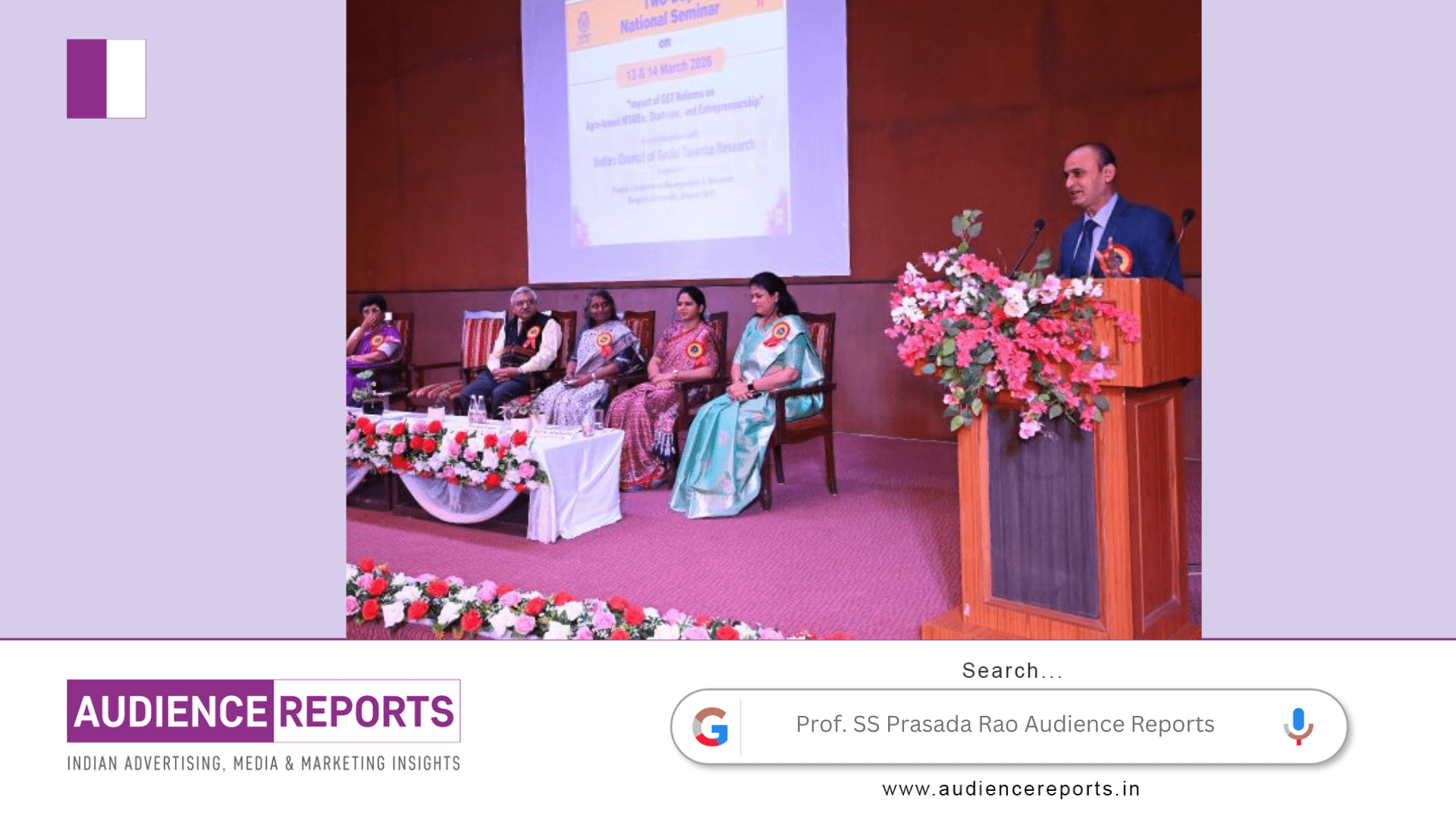
Prof. SS Prasada Rao, shared these perspectives while delivering the keynote address at the National Conference on “Impact of GST Reforms on Agro-based MSMEs, Start-ups, and Entrepreneurship.” The discussion served as a valuable platform for scholars, practitioners, researchers, and policymakers to examine the evolving relationship between tax reforms and rural economic development. The insights offered by Prof. SS Prasada Rao, reinforce the idea that empowering rural enterprises is not merely an economic objective; it is a pathway toward a more inclusive, resilient, and prosperous India.