































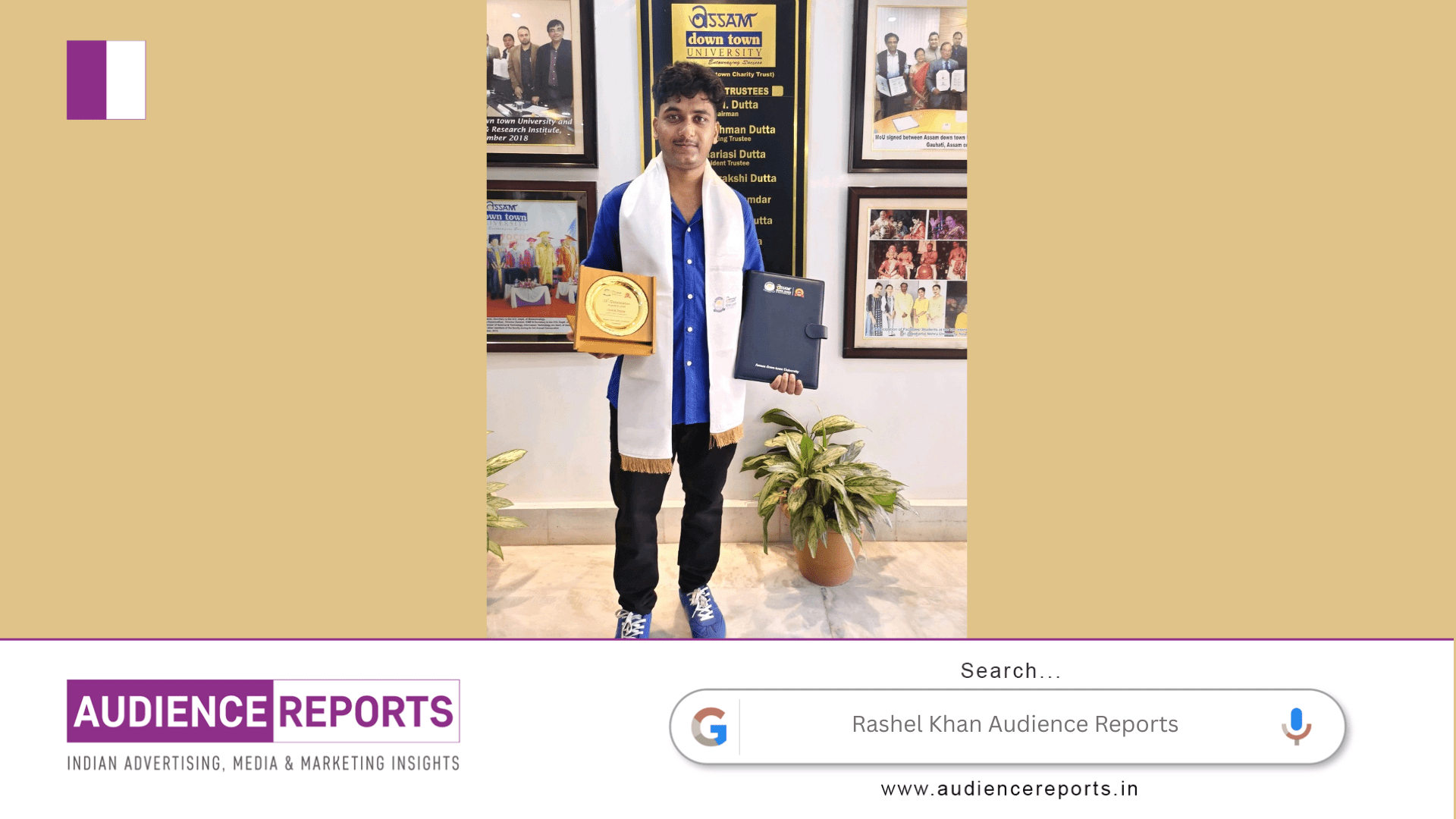
Rashel Khan stands at an important transition point: one chapter has ended with graduation, while another is beginning with the ambition to build a startup in India’s real estate and home-construction ecosystem. For Rashel Khan, graduation is not simply a conclusion to university life. It represents the starting line for a much larger challenge turning an idea into something that can create practical value for people.
The transition from student to founder is rarely straightforward. Education can provide knowledge, but entrepreneurship demands something different: persistence, decision-making, adaptability, and the willingness to keep moving when results are uncertain. Rashel Khan recognizes that the journey ahead will involve failures, difficult decisions, unexpected obstacles, and lessons that cannot be learned from a classroom alone.
At the center of Rashel Khan’s vision is the real estate and home-construction industry. Building a home is one of the biggest financial decisions most people make, yet the process can often feel complicated. From finding suitable land and understanding costs to selecting contractors, managing construction, and keeping track of budgets, homeowners can face numerous challenges.
Rashel Khan wants to explore how this process can become simpler, more transparent, and more accessible. The vision extends across different economic groups, from lower-middle-class and middle-class families to high-end customers. The ambition is particularly broad: creating possibilities for budget-friendly homes while also addressing projects at a much larger scale, ranging from homes costing around ₹10 lakh to luxury properties and developments worth hundreds or even thousands of crores.
That range makes the idea ambitious, but ambition alone does not create a successful company. Rashel Khan will need to convert the vision into a clear business model, understand customer needs, build reliable processes, establish strong partnerships, and develop a reputation based on transparency. In real estate, trust is not an optional feature. It is one of the foundations on which long-term businesses are built.
For Rashel Khan, the phrase “Day 1” carries significance because it emphasizes that the vision is still at its beginning. There is a considerable distance between having a concept and building a sustainable organization. The early stage is where assumptions have to be tested, customer problems need to be understood, and ideas must be refined through real-world experience.
The most important part of this phase may be learning to treat setbacks as information rather than as final judgments. Rashel Khan has already acknowledged that failures and uncertainty will be part of the journey. That recognition matters because entrepreneurship is rarely a straight line. Some ideas will work, others will require modification, and some may need to be abandoned altogether.
Consistency will therefore be more important than occasional bursts of motivation. Rashel Khan’s reference to hard work and self-belief reflects the personal discipline required to continue working when external validation is limited. Building a startup requires showing up repeatedly researching the market, speaking with customers, improving the product or service, managing finances, developing a team, and responding to problems.
There is also a broader dimension to Rashel Khan’s goal. The ambition is not limited to creating a personal career or business opportunity. The stated objective is to build something that contributes to India’s real estate and construction ecosystem. If pursued responsibly, a business focused on simplifying construction could potentially address meaningful problems around affordability, accessibility, communication, and transparency.
However, creating that impact will require more than a strong vision. Rashel Khan will have to balance aspiration with execution. A company serving customers across such a wide range of budgets would need different strategies, operational systems, financing considerations, technology, and quality standards. The bigger the vision becomes, the more important the fundamentals become.
The journey from university graduate to founder is therefore not simply a change in professional title. It is a change in responsibility. As Rashel Khan moves forward, every decision will contribute to shaping the kind of company he ultimately wants to build. The lessons may come from successful projects, failed experiments, customer feedback, market changes, and difficult moments.
Rashel Khan’s story is beginning at a point many young graduates understand well: standing between the security of what is familiar and the uncertainty of what could be created. The difference is the decision to pursue the uncertain path and attempt to build something of lasting value.
The graduation chapter has closed, but Rashel Khan’s entrepreneurial chapter has only begun. The vision is ambitious, the challenges are real, and the distance between the two will be covered through execution, learning, consistency, and time.
Day 1 is not proof that the destination will be reached. It is simply proof that the journey has started.
And sometimes, every extraordinary venture begins with exactly that decision to start.