

































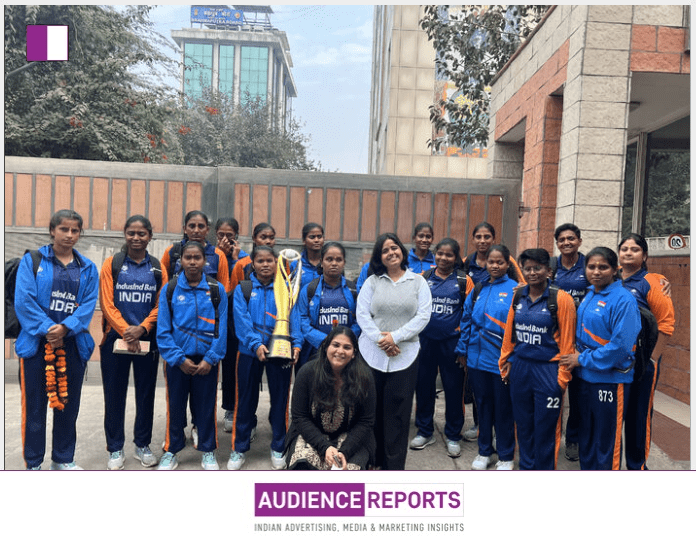
Pratima Mukherjee has always believed that real transformation begins where comfort ends, and her recent encounter with India’s Women’s Blind Cricket Team echoes this truth with profound clarity. Pratima Mukherjee, as the State Coordinator at the Ministry of Social Justice & Empowerment (MoSJE), Government of India, stands at a place where stories of courage and resilience unfold every day. Yet, this meeting left an impact that she felt compelled to share not for applause, but for awareness, reflection, and inspiration.
Pratima Mukherjee describes her experience not as a ceremonial moment, but as a powerful reminder of what true grit looks like. Standing beside the world’s first Blind Cricket World Cup Champions India’s own women she felt the depth of what it means to persevere against odds that most people cannot even imagine. These athletes, as Pratima Mukherjee highlights, are not just players on a field; they are pioneers rewriting the definitions of strength, ambition, and possibility.

In her reflection, Pratima Mukherjee emphasizes that these women represent far more than a victorious team. They symbolize the courage of an entire generation of women refusing to be constrained by circumstance. They rise not occasionally, but consistently. They train through barriers, push through limitations, and carry their dreams with the kind of determination that reshapes society’s understanding of capability.
Pratima Mukherjee notes how these athletes confront challenges that are invisible to most, yet undeniable in their intensity. From navigating daily realities without sight to excelling in a sport that demands precision, reflex, and pressure-handling, their every step is an act of extraordinary strength. But what struck Pratima Mukherjee most was not their struggle it was their confidence. Their unshakable belief in themselves. Their refusal to let adversity steal their joy or ambition. Their willingness to stand tall as champions, not because life was easy, but because they insisted on rising above every barrier.
This is why Pratima Mukherjee sees their journey as a powerful example of leadership. True leadership, she believes, isn’t anchored in titles or positions. It is found in the choices we make when life tests our limits. It is found in the discipline to continue, the humility to learn, and the resilience to start again values these athletes embody with grace and purpose.
Working in the social sector, Pratima Mukherjee meets many inspiring individuals whose stories remind her of the immense potential within communities that often go unseen. But meeting the Women’s Blind Cricket Team left her profoundly moved. Their story is not just about winning trophies; it is about winning the internal battles that shape one’s identity. It is about embracing purpose with conviction. It is about teamwork that surpasses individuality, about unity that strengthens resolve, and about optimism that sustains dreams.
For Pratima Mukherjee, their victory is also a call to society a call to recognize, celebrate, and support every woman breaking barriers. She believes that their achievements should not remain within the sports arena but should inspire change in every household, institution, and policy. Their journey shows what can happen when talent is supported, opportunities are created, and determination is honored.
As Pratima Mukherjee reflects on this experience, she envisions a future where countless more women will step forward with courage, whether in sports, education, leadership, or service. She hopes that stories like these reach young girls across the nation, reminding them that limitations are not destinations but starting points for new pathways. She hopes these champions become symbols of belief proof that you can rise regardless of circumstances, and that possibilities expand when you dare to challenge them.
Pratima Mukherjee also highlights the importance of collective responsibility ministries, institutions, associations, and communities coming together to create environments where such talent can flourish. She acknowledges the powerful effort of the Cricket Association for the Blind in India, the Ministry of Social Justice & Empowerment, the Ministry of Women and Child Development, and the Board of Control for Cricket in India. To her, this collaboration is not just administration; it is empowerment in action.
In celebrating these world champions, Pratima Mukherjee invites the nation to look beyond victory and see the larger narrative a narrative of breaking ceilings, redefining ability, and turning challenges into stepping stones. A narrative where women stand as pillars of strength, courage, and possibility. A narrative that encourages society to raise its expectations, broaden its perspectives, and deepen its support.
And as Pratima Mukherjee concludes, this moment is not the end it is the beginning. The beginning of more recognition, more victories, and more pathways for women rewriting history. It is a reminder that when one woman rises, she lifts countless others with her. These athletes have shown the world not only how to play but how to live with purpose, resilience, and unwavering spirit.
Through her reflection, Pratima Mukherjee reminds us that champions are not only found on fields they are found wherever courage meets opportunity. And when that happens, the world moves forward, one extraordinary story at a time.