

































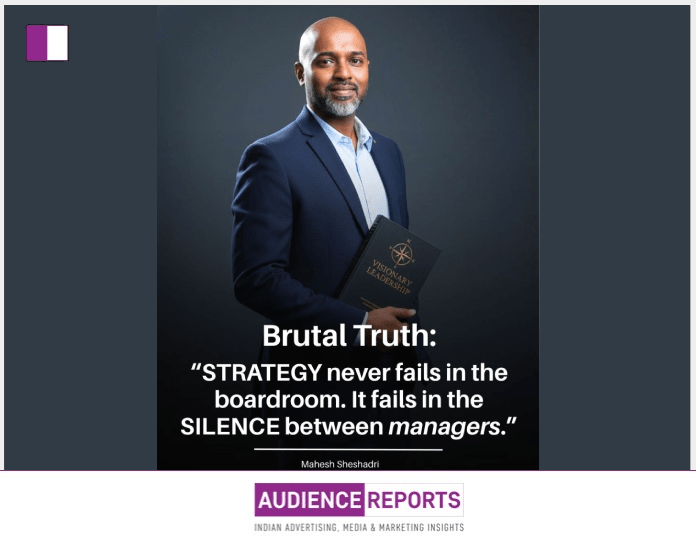
Mahesh Sheshadri has spent enough time in the trenches of organisational transformation to recognise a pattern that many leaders overlook: execution rarely fails because of a bad strategy it collapses because people stop speaking. And in his recent reflection, Mahesh Sheshadri captures this truth with the clarity of someone who has seen both the brilliance of great plans and the quiet weight of unspoken resistance.
Mahesh Sheshadri describes walking into a room where everything looked perfect on paper well-defined goals, a robust strategy, and leadership committed to success. Yet the room was silent. Not the silence of harmony, but the silence that signals hesitation, uncertainty, and emotional distance. It’s the silence leaders often misinterpret as consent, when in fact it is the early sign of misalignment. Mahesh Sheshadri points out that the middle layer the layer critical for translation of strategy into action was present but unconvinced. And where conviction is absent, execution slows to a crawl.

This is the kind of organisational silence Mahesh Sheshadri warns leaders about: a deceptive calm that hides fear, overload, confusion, and a lack of buy-in. Teams may not challenge the direction, but they also won’t move with the energy and clarity needed to deliver on it. Silence may feel like agreement, but as Mahesh Sheshadri emphasises, it is often a sign that leaders are navigating a minefield of unspoken concerns.
The middle layer sits at a unique crossroads. They hear the intent from the top and feel the pressure from the frontline. They manage execution while absorbing shockwaves from every direction. When this layer doesn’t feel heard, empowered, or aligned, the entire organisational engine destabilises. Mahesh Sheshadri has seen this dynamic repeatedly across startups that are scaling too fast, MSMEs juggling complexity, and established teams navigating transformation.
To address this, Mahesh Sheshadri and his team didn’t prescribe another meeting, another presentation, or another cascade of top-down instructions. Instead, they introduced something deceptively simple: Stakeholder Mapping and Influence Labs. The power of this approach lies not in new information, but in enabling new conversations. By mapping who held influence, who felt excluded, who was quietly disengaged, and who lacked a voice entirely, the team unearthed the relational truth beneath the organisational chart.
This is where Mahesh Sheshadri’s approach stands out. He understands that alignment isn’t achieved through documents or dashboards it is built through dialogue. Managers were coached not merely to communicate, but to communicate with clarity, direction, empathy, and ownership. Upward, sideways, and downward. When communication becomes multidirectional, teams stop being passive recipients of strategies and become active participants in execution.
And then something shifted. Conversations opened. Decisions accelerated. People who once felt sidelined stepped into ownership. Within 60 days, the organisation saw a 30% improvement in execution speed not because the strategy evolved, but because the people did. As Mahesh Sheshadri puts it, strong strategy means nothing if the middle layer is silent. Execution begins the moment they start speaking again.
The insight Mahesh Sheshadri brings forward is relevant to any organisation, regardless of size or industry. In many companies, misalignment is incorrectly interpreted as resistance. Leaders assume the middle layer is delaying, disagreeing, or disengaged. But in reality, many are simply unclear about expectations, disconnected from decision-making, or weary of being unheard. Silence becomes a coping mechanism, not a rebellion.
By highlighting this, Mahesh Sheshadri calls leaders to pay attention to the social architecture of their teams. Strategy lives in documents, but execution lives in interactions. If the human system underneath is strained, success becomes accidental rather than intentional. But when the system is aligned when the middle layer’s voice is restored momentum becomes natural.
This perspective reflects the core philosophy behind HumanAlpha, the firm Mahesh Sheshadri co-founded: organisations transform when people transform. Tools, processes, and plans matter, but they are secondary to human alignment. And alignment doesn’t emerge from silence; it emerges from meaningful conversation.
In today’s workplaces where change is rapid, expectations are complex, and teams are stretched leaders need more than strategic brilliance. They need the ability to listen, truly listen, before they expect action. As Mahesh Sheshadri illustrates, buy-in breaks not at the frontline or the leadership table, but most often at the middle where silence is mistakenly accepted as agreement.
The message from Mahesh Sheshadri is clear: execution is not a downstream activity. It is a shared responsibility powered by shared understanding. When leaders make space for dialogue, when managers are empowered to influence, and when teams feel heard, silence dissolves and energy returns.
And perhaps the most important question Mahesh Sheshadri leaves us with is one every organisation must confront: Where does buy-in break down most top, middle, or frontline? The answer to that question could be the difference between a strategy that merely exists and a strategy that truly succeeds.