


































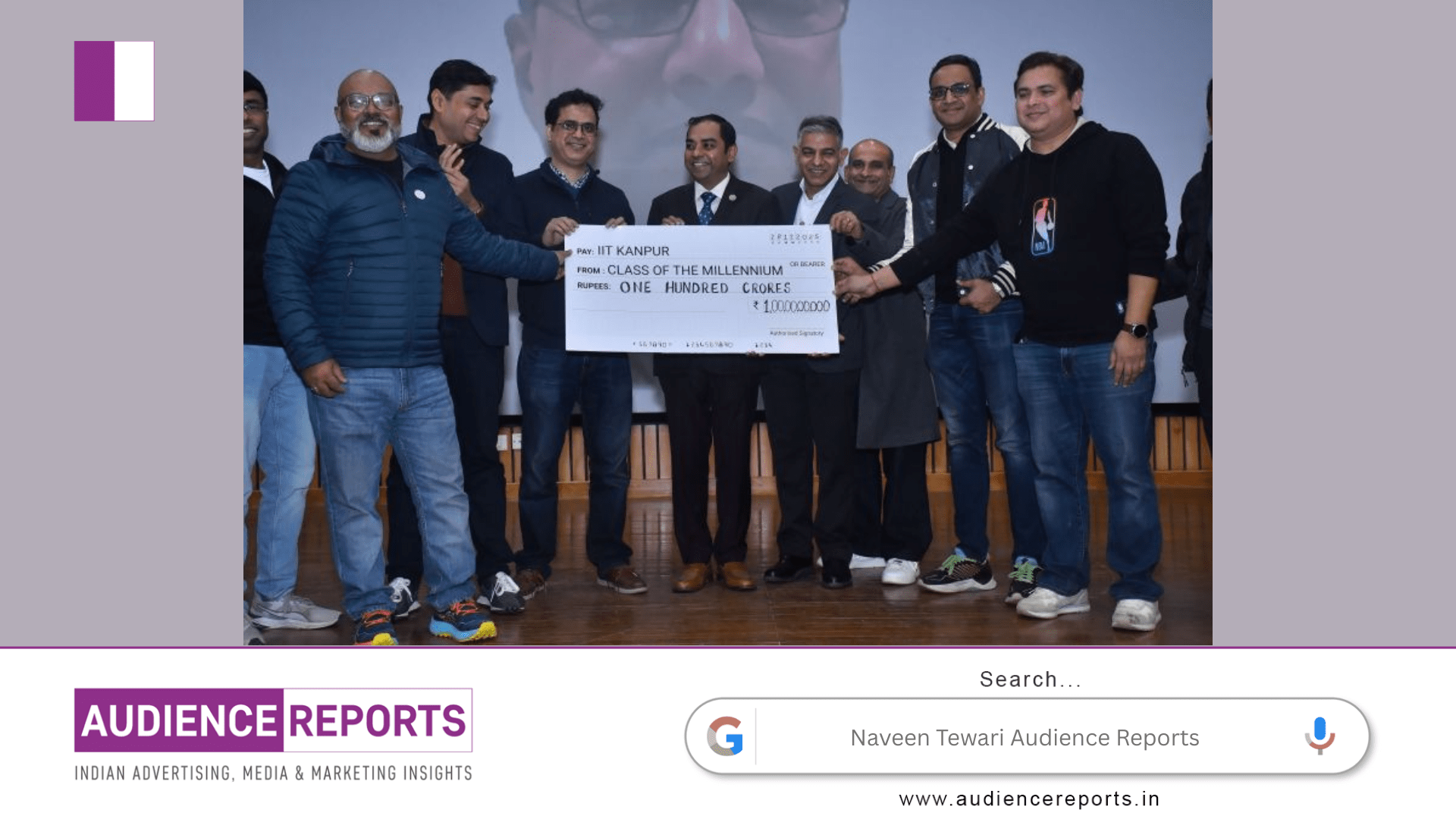
Naveen Tewari once walked out of IIT Kanpur with little more than a degree and a set of questions about what could be built in the world. Two and a half decades later, he walks back with something rarer: perspective. The announcement of the Millennium School of Technology and Society (MSTAS) is not a story about a donation alone. It is a story about how time reshapes ambition, from building companies to building institutions.
Naveen Tewari’s post is anchored in a simple memory: “a degree and a dream.” It is a phrase that carries weight because it strips success of its gloss. Degrees age. Dreams evolve. What remains is the mindset that education plants. IIT Kanpur did not merely train engineers; it cultivated people who learned to question assumptions and engage complexity without fear. MSTAS is an extension of that ethos, scaled for a new era.
The Class of 2000’s ₹100 crore pledge is unprecedented in Indian academic history. Yet, what makes it meaningful is not the number. It is the collective decision by a generation to invest in something that will outlast their own careers. Naveen Tewari frames this as continuity, not charity. MSTAS is not a monument; it is infrastructure for thought, designed at the intersection of technology, policy, and society.
This matters because the world no longer faces “technical” problems alone. Climate change, digital governance, misinformation, health systems, and urbanization cannot be solved by code or capital in isolation. They require leaders who understand systems, trade-offs, and human consequences. MSTAS is positioned to train such leaders. In doing so, it reframes what elite education should aim for: not only innovation, but responsibility at scale.
Naveen Tewari’s journey mirrors this shift. From founding InMobi to building Glance, his career has unfolded in the high-velocity world of technology. But this post does not speak the language of markets or growth curves. It speaks the language of legacy. That pivot is instructive. It suggests that maturity in leadership is not about accumulating more, but about redirecting momentum toward shared futures.
There is restraint in how Naveen Tewari describes the moment. He does not claim heroism. He thanks batchmates. He credits professors. He invites others. The emphasis is collective. This is not the narrative of a lone benefactor; it is the architecture of a cohort deciding that its influence can be institutional rather than episodic.
Education often sells itself as a ladder for individual mobility. MSTAS challenges that framing. It treats education as a platform for societal leverage. By embedding technology within policy and social transformation, it refuses the myth that progress is neutral. It acknowledges that every innovation carries implications, ethical, political, environmental. Leaders trained in such an environment will not only ask, “Can we build this?” but “Should we?” and “For whom?”
Naveen Tewari’s reflection on IIT Kanpur, “not just skills, but the courage to question assumptions”, is quietly radical. Questioning assumptions is expensive. It slows momentum. It creates friction. In startups, friction is often seen as failure. In societies, it is the beginning of wisdom. MSTAS institutionalizes this friction, making it part of formal training rather than an afterthought.
The invitation at the end of the post is as important as the pledge itself. Naveen Tewari does not present MSTAS as finished. He presents it as open-ended. “We invite alumni and thought leaders to join us.” This is a design principle: treat institutions as living systems. Allow them to be shaped by diverse intelligence over time. That openness is what prevents legacy projects from becoming static.
There is also a deeper message for India’s entrepreneurial ecosystem. Philanthropy here has often been reactive, responding to crises, filling gaps. MSTAS represents a proactive form of giving. It invests upstream, in the formation of thinking itself. It assumes that the most durable change happens before problems become emergencies.
Naveen Tewari’s post does not romanticize the past. It does not claim that IIT Kanpur was perfect. It acknowledges what it gave: courage, not certainty. That distinction matters. Education that promises certainty becomes obsolete quickly. Education that builds courage remains relevant across decades.
In a culture obsessed with exits and valuations, this moment offers a different metric of success. It asks: what structures will exist because you passed through the world? Not what you built for yourself, but what others will build because you were here.
Naveen Tewari stands in this story not as a symbol of arrival, but as a bridge between phases of ambition. The first phase is personal: learn, build, survive. The second is collective: enable, endow, sustain. MSTAS belongs to the second phase.
When future students walk through its halls, they may not know the names behind its founding. That is as it should be. Institutions succeed when they outgrow their creators. Naveen Tewari’s role is not to be remembered by every student, but to ensure that those students inherit an environment that teaches them to think beyond themselves.
In that sense, the post is not about nostalgia. It is about trajectory. Twenty-five years after leaving campus, Naveen Tewari returns not to close a circle, but to widen it. The real gift is not ₹100 crore. It is the belief that education must evolve as fast as the world it serves, and that those who benefited from it carry a responsibility to shape its future.