


































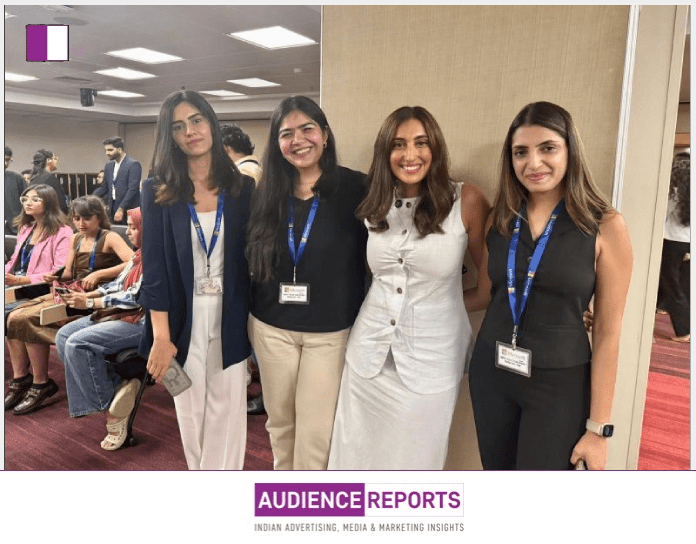
Gayatri Agrawal steps into every room with an awareness shaped by experience, ambition, and an unshakeable commitment to representation. Gayatri Agrawal understands that walking into spaces dominated by a certain demographic is not just a professional moment it is a reminder of how much work remains. Gayatri Agrawal sees the gap clearly: the number of women in AI who are not merely participating but truly building is still painfully small. And it is from this observation that she draws a larger narrative, one that deserves attention far beyond Silicon Valley’s high-pressure conference rooms.
Gayatri Agrawal reflects on her time in the United States, where two worlds of AI coexist one defined by extreme ambition and another defined by creative experimentation. In Silicon Valley, she felt what many founders describe but rarely admit: the intimidating, almost overwhelming pulse of creation where billion-dollar valuations and aggressive scaling feel like the baseline, not the finish line. Gayatri Agrawal noticed that this environment rewards speed, precision, and relentless drive. Yet even in a place obsessed with the future, the number of women shaping that future remains shockingly low.

Then came LA a contrast in texture and tone. Gayatri Agrawal experienced a different flavour of innovation there, where AI is not just a tool for efficiency but a canvas for expression. From animated films to AI-remixed music to virtual influencers, the city radiates a playful belief that technology can be a creative partner. Still, amid this artistic chaos, Gayatri Agrawal observed something else: even in this more inclusive, expressive ecosystem, women, especially non-US women, are rare at the forefront of AI creation.
These two worlds Silicon Valley’s intensity and LA’s expressive energy made Gayatri Agrawal realise something important: the scarcity of women building, leading, and directing the AI revolution is not just a Western problem or an Indian problem; it is a global one. Gayatri Agrawal believes this conversation is overdue. While much has been said about empowering women in tech, far less has been done to ensure that women are not merely invited into the room but are positioned at the table where decisions are made.
As the Founder of ALTRD, Gayatri Agrawal leads an AI company from India that has scaled solutions across retail, telecom, OTT, and other industries. Her work proves that meaningful AI innovation does not require a Silicon Valley postcode. It requires clarity, momentum, and conviction. Gayatri Agrawal emphasises that women do not need permission or validation from established systems to build groundbreaking companies. What they need is backing resources, belief, and opportunities aligned with their vision.
Gayatri Agrawal often speaks of how momentum matters more than perfection. Women founders are sometimes conditioned to over-prepare and under-pitch, waiting until they can deliver flawless prototypes or airtight models. Yet the AI world moves fast an early start, even if imperfect, can be more powerful than a perfect beginning that comes too late. Gayatri Agrawal insists that women don’t need to catch up to anyone. They simply need to stop being underestimated and start being supported.
At the heart of her message is something deeper: belief. Gayatri Agrawal knows that belief is the hardest currency in entrepreneurship. Markets shift, funding cycles tighten, technology advances but self-belief must remain constant. She acknowledges that many women in AI walk into rooms where they are the statistical exception. In such spaces, believing in oneself when no one else does becomes a form of quiet rebellion. Gayatri Agrawal sees that rebellion as the beginning of change.
AI is no longer a niche domain; it is shaping culture, economies, geopolitical influence, and the narratives that define society. This is why Gayatri Agrawal insists that women must not only join conversations around AI but lead them. Leadership in AI is not just about technical expertise it is about framing the values, ethics, and direction of the ecosystems being built. Without diverse leadership, the future risks being designed through a narrow lens.
Gayatri Agrawal also recognises that many women are already doing the work quietly learning models, experimenting with tools, building prototypes, or dreaming of a product that solves a real problem. Her call is simple but bold: don’t wait for permission, timing, or validation. Reach out, step in, and build. Gayatri Agrawal extends this invitation openly, urging women founders or women who aspire to become founders to connect, collaborate, and take the leap.
Her message is not a rallying cry rooted in emotion but a call grounded in lived experience. Gayatri Agrawal has walked into intimidating rooms, pitched ideas that felt ahead of their time, and navigated biases that often remain invisible to those who don’t face them. But through it all, she has built built products, built a company, built conviction. And now, she wants more women to build alongside her.
The future of AI is being written now. Whether those chapters include more women at the helm will depend on how many choose to step forward despite the odds. Gayatri Agrawal believes the time is now, and the invitation does not need to come from powerful rooms in California. It can start with a message, a prototype, an idea, or a simple decision to believe in oneself.
Let’s stop waiting to be invited in. The doors may not open themselves but women like Gayatri Agrawal are already pushing them wider.